
Born in Scotland in 1550 into a family of wealthy landowners, John Napier—whose name was Frenchified as Neper so that people in France would pronounce it as it is across the Channel—left the University of St Andrews without a degree. A staunch Protestant and the author of a fiercely anti-papal work of theology, he was not, strictly speaking, a mathematician. Seeking to lighten the workload of navigators and astronomers, and concerned with spherical trigonometry, he wrote a handy guide to solving spherical triangles and a few formulas known as Napier's analogies; hardly enough to ensure lasting fame. He owes his renown to the brilliant insight that led him to invent something that would revolutionize computation: logarithms.
-
Twenty years of logarithms
------------------------
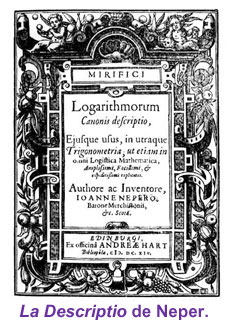
Like Pierre de Fermat (c. 1601–1665), Thomas Bayes (c. 1702–1761) and Gottfried Leibniz (1646–1716) after him, John Napier began as an accomplished amateur mathematician. Mathematics was not his profession but his favorite pastime, and he pursued it with the aim of lightening the workload of everyone who had calculations to perform.