Start with an isosceles triangle AMS. Want to divide angle into three equal angles? It is easy: draw the circle (C) with center A, passing through S and M, and radius R = AS = AM. Now mark two points O and P a distance R apart on a ruler, then slide O along line (AS) and P along circle (C): when the ruler passes through M, angle trisects angle .
Take a close look at the figure. You will find the proof using only the facts that the base angles of an isosceles triangle are equal and that the angles of a triangle sum to 180°.
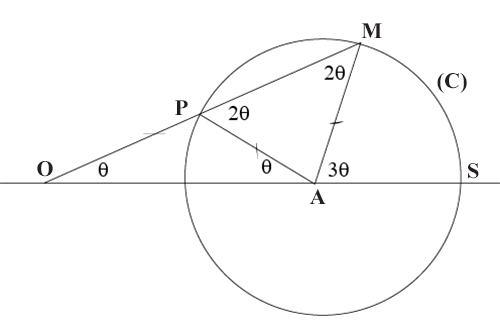
This beautiful construction was discovered by the Greeks, who were great enthusiasts of angle trisection; it is in fact Proposition VIII of the Livre des lemmes (Book of Lemmas) in Archimedes’ Œuvres complètes (Complete Works). But although the instruments used are a straightedge and compass, this is not a "straightedge-and-compass" construction, because O and P cannot be constructed by successively drawing circles and straight lines.
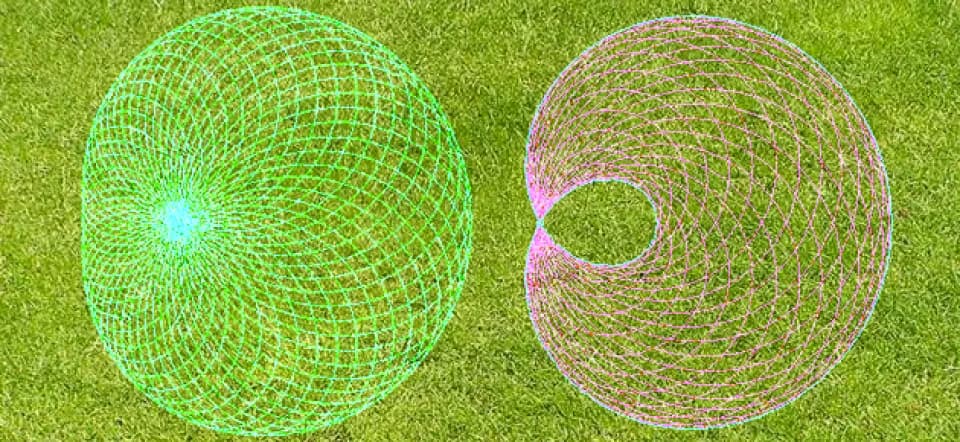
Now let the angle θ vary while A and O remain fixed: M then traces out a curve, the Maclaurin trisectrix, which Colin Maclaurin (1698–1746) defined and studied in 1742. Once drawn, this curve can be used to trisect any angle. Here we reach the limits of straightedge-and-compass constructions, and this time algebra comes to the aid of the instruments in uncovering new properties.