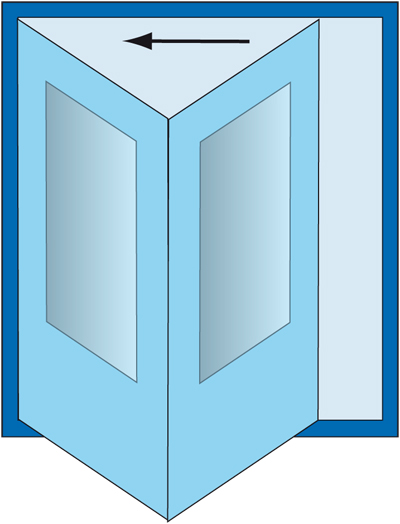
Dry and pointless, the concept of envelopes of lines? Think again! Consider a concrete example: a folding two-panel bus door. When the bus is stationary and the door closed, its projection on the ground consists of two line segments. As the door opens, the left-hand segment pivots, sweeping out a quarter-disk. The right-hand segment is more interesting to study.
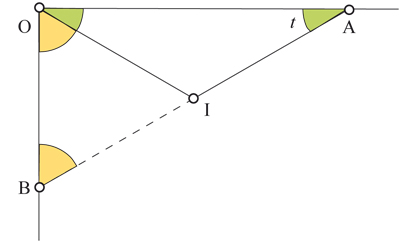
The projection of the door's right-hand panel onto the ground is a line segment. As the door moves (see the diagram below), this segment lies on a line intersecting two perpendicular lines: (OA), representing the axis of the closed door, and (OB), representing the axis of the open door. These intersections define a segment [AB] whose length is constant, equal to that of the entire door. Triangle OAI is isosceles because the two door panels [OI] and [IA], in their current position, have the same length. Likewise, OBI is isosceles because the two door panels [OB] and [IO], in their final position, have the same length. Thus, [AB] has constant length (see FOCUS).
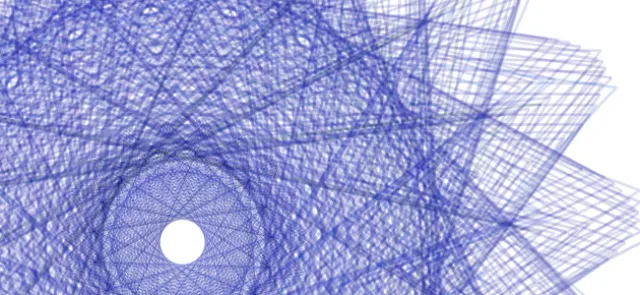
It is easy to draw a large number of segments [AB]. A curve then emerges in negative space. This envelope has two distinct properties. First, it bounds the area swept out by the door—the area where one can stand without being knocked aside. Second, all the lines (AB) are tangent to the envelope. This property lends itself better to computation than the first.