



Envelopes of families of lines
When we consider a family of lines, there often exists a curve that is tangent to each one of them: this is the envelope of that family. Its equation can be computed from the parametrization of the lines. What a delight for the eye to see these geometric figures made of cleverly placed lines along which a beautiful curve winds, seeming to brush against each one of them! Among the curves constructed this way, which can be recognized in folding or in tables of stretched threads, we find some well-known figures such as conics. Light rays reflecting off a surface also draw beautiful curves, called caustics. Passionate about optics and close to Leibniz, the Count of Tschirnhaus understood the importance of differential calculus for studying them. The evolutes of curves, envelopes of normals, also offer beautiful geometry!
All articles in this folder
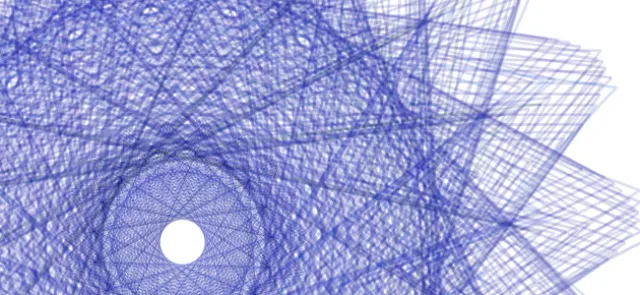
Family reunion
Some geometric figures are a delight to behold: a host of skilfully arranged lines, intertwined with a graceful curve that seems barely to touch each one. What mathematical theory lies behind them? The theory of envelopes of lines.

Envelopes, moving points and evolutes
The envelope of a family of lines can be understood in two ways. The second lends itself better to computation, but both give rise to superb geometric questions.

Simson line and Steiner's hypocycloid | Tangente
This delightful geometric property was familiar to French secondary-school students in the 1970s, although few knew how to prove it.

Equilateral triangles from any triangle | Tangente
There are at least two ways to derive an equilateral triangle from any triangle T—in other words, to obtain a triangle with the greatest possible symmetry from one that initially has none.

Knuth's octagons
The American mathematician Donald Knuth created TeX, a mathematical typesetting system based on Bézier curves.
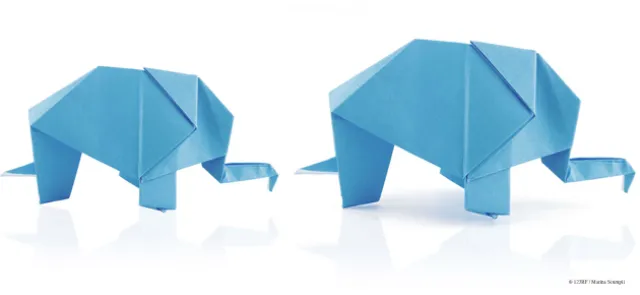
Envelopes by folding
Every regular curve is the envelope of all its tangent lines. For conics, these tangent lines are particularly easy to construct geometrically, making it possible to produce them by folding.
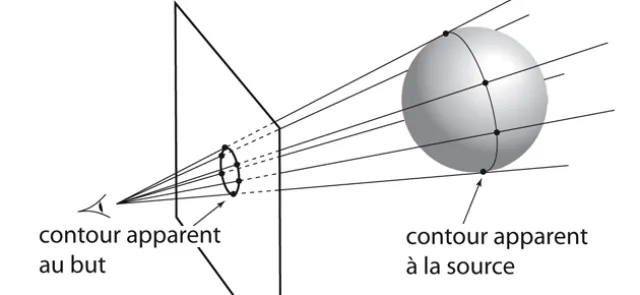
The envelope of a family of curves
Defining the envelope of a family of lines precisely is subtler than it appears. This becomes clear when we try to extend the idea to an arbitrary family of curves. René Thom's approach provides a way around the difficulties.