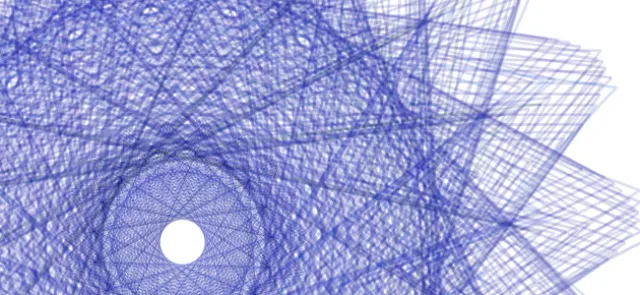
We have managed to define the envelope of a family of lines, a mathematical object that gives rise to some lovely properties and geometric figures. Why not take the idea further and define an envelope for a family of curves (C *t ) t*?
A natural first definition would be: "A curve or line tangent to every curve C *t , for every real number t." A second, more rigorous definition would be: "The locus of characteristic points, namely the points common to the curve C t and an 'infinitely close' curve in the family—that is, a curve C t*’ , where t’ is "infinitely close" to t." Can these two viewpoints be reconciled?
The case of lines
-----------------
In fact, the two proposed definitions are... "almost" equivalent. Let us see why for a family of lines (D*t ) t , with general equation a(t)x + b(t)y + c(t) = 0. A real number "infinitely close" to t can be written t’ = t + dt, with dt "small." The only computational rule we need is f(t + dt) = f(t) + f’(t)dt when f* is differentiable.
The line "infinitely close" to D *t* has equation: