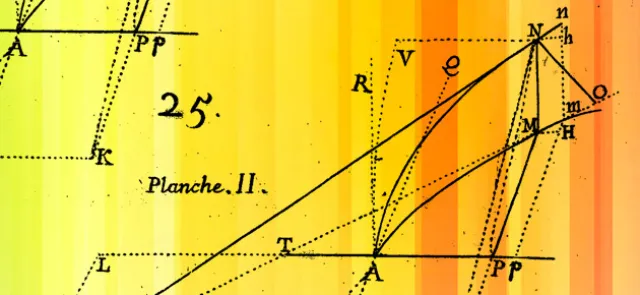
"Brachistochrone": what a strange name for a curve! Yet it is far more than a simple geometric object: it is the solution to an optimization problem that kept 17th-century mathematicians on tenterhooks, even the most seasoned among them, and ultimately spread to other fields, giving rise to the calculus of variations.
The fastest path: the early days
--------------------------------
The problem was initially posed in simple terms: find the straight line along which a point can travel as quickly as possible from A to a point B lying on a vertical line. This is the straight-line brachistochrone problem (from two Greek words meaning "shortest" and "time").
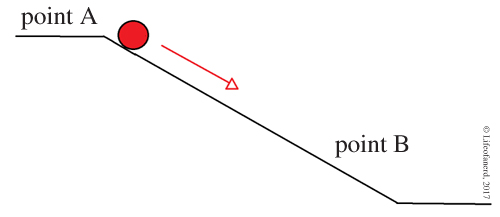
The solution came from Galileo, who calculated in 1638, in his Discours sur deux nouvelles sciences (mechanics, or the study of motion, and the strength of materials), that such a line must make an angle of 45° with the vertical. He then calculated that if a falling point traveled from A to B along straight lines, it would reach B more quickly by following the line segments [AC] and then [BC], where C lay on an arc of a circle. But when he generalized this last result, concluding that "it seems possible to conclude that the fastest motion between two points does not take place along the shortest line—that is, along a straight line—but along an arc of a circle," he was mistaken, probably because he lacked the results of differential calculus that would have made the problem easier to solve.