
With n = 3 line segments, we can draw one triangle. With n = 4, how many distinct, non-overlapping triangles can we draw? The answer is two. Problems quickly arise as n increases! The question was posed in 1978 by the Japanese mathematician Kobon Fujimura (see Tangente SUP 46, 2008) and popularized in 1983 by Martin Gardner, the pre-eminent expert on recreational mathematics.
Soon afterward, Saburo Tamura proved that the maximum number of triangles formed by n line segments is bounded above by the floor of
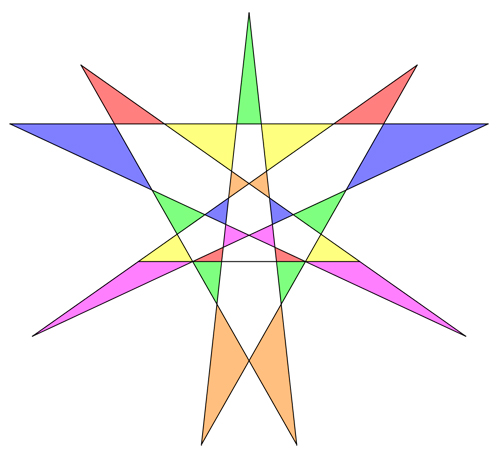
Twenty-five triangles from ten line segments. Can you do better?
Other mathematicians have proved more recently that this bound cannot be attained if n is a multiple of 6 or two more than a multiple of 6. The optimal results are known up to n = 9, but uncertainty remains starting at n = 10: can twenty-six triangles be obtained? Something to keep you busy on those long winter evenings!