Six circles of radius 1 can be arranged around another circle of the same radius, and it is impossible to fit in any more. The plane's number of kisses (or kissing number) is 6.

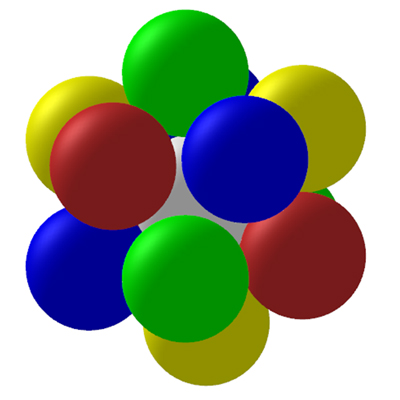
What about in three dimensions? What is the maximum number of spheres of radius 1 that can be arranged around another sphere of radius 1? The result was conjectured long ago: twelve spheres can be arranged around another sphere of the same radius. Proving this was far from straightforward: it was not achieved until the mid-20th century. Unlike in the plane, a great deal of space remains around the central sphere—enough to slide any two of the twelve spheres around and swap their positions without any of the others losing contact with the central sphere... but not enough to squeeze in a thirteenth!
What about higher dimensions? For n = 4, 8 and 24, the kissing number is 24, 240 and 196,560, respectively. For other values, only a few bounds are known: for n = 5, the answer lies between 40 and 44, while the kissing number in dimension 23 lies between 93,150 and 124,416.