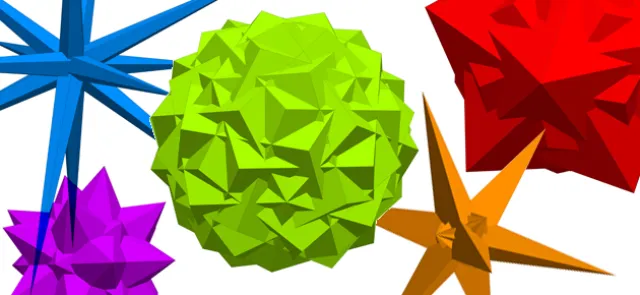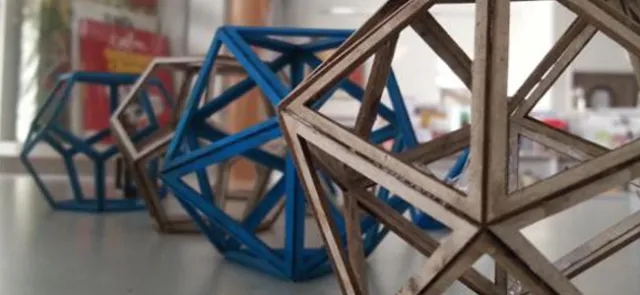
In the Timaeus, Plato describes the five regular solids. These polyhedra are all inscribed in a sphere, the perfect shape of the ancient Greeks. Archimedes gave a list of thirteen semiregular solids, still inscribed in the sphere. But his text is lost; no one knows how he went about obtaining them.
Between the Renaissance and the end of the 19th century, these solids were rediscovered time and again, but there was as yet no procedure for deriving them simply and systematically from the regular solids. Discovering the semiregular solids of the fourth dimension was thus no easy task. The Irish mathematician Alicia Boole Stott discovered an elementary method that allowed her to rise to this challenge and shed new light on the semiregular polyhedra.
Already, in the plane
------------------
Take a square. There is a circle circumscribed about this square. But, more interesting, there is also a circle inscribed in this square. The square's four sides are tangent to this circle at the midpoint of each side.
Change our point of view: instead of seeing the square as a "single-piece polygon," picture it as four sides fixed on a circle. If the circle's radius is cleverly chosen, we obtain a square, as the endpoints of the segments coincide; but in every other case (with a circle of larger radius), they are disjoint. We can then connect them with new sides to form a new polygon (here, an octagon), which will be regular for a certain value of the circle's radius.