
The tangency
All folders in this issue


With circles
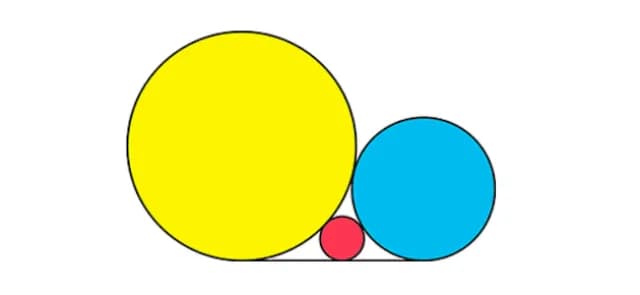
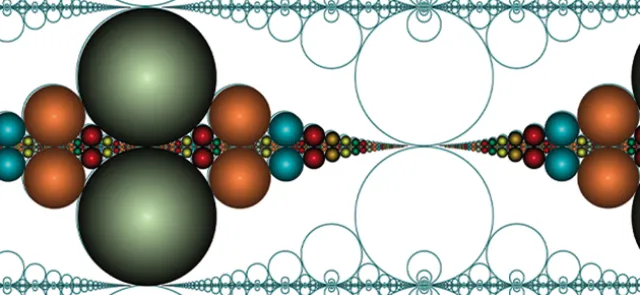
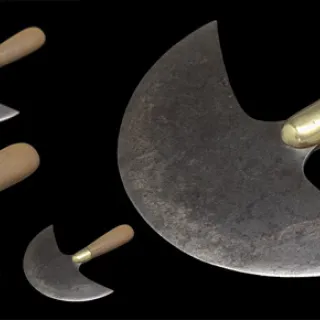
In plane geometry, the tangent, we all know it... as soon as the construction features a circle (C), a line (D) and a point P. However, there are far richer situations! With only tangent circles, an extraordinary diversity emerges. Thus the arbelos, whose vertiginous iterative construction gives rise to countless properties, each more astonishing than the others, fascinated the Ancients. Archimedes' twin circles and the chains of Pappus plunge us into the heart of one of the most elegant geometric transformations, inversion. Closer to us, Malfatti circles allow us to revisit from another angle the notion of incircle. Tangency has not finished amazing us!
Curves and lines
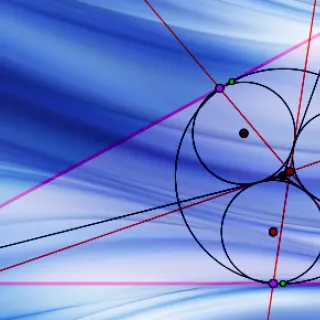
The infinite variety of trajectories in the plane seemed to escape any classification. Yet, smooth curves share a common property: when one "zooms in" on a generic point, one "sees" a line! The notions of tangent and derivative made it possible, quite belatedly, to formalize this observation. The tangent remains today a powerful universal tool for studying curves and trying to uncover their properties. However, be careful not to confuse the tangent to a curve with its asymptote at infinity. A priori, no confusion is possible. But beware of hasty conclusions: projective geometry has surprises in store for you!



A versatile tool
Due to its properties, the tangent can be interpreted in various ways: line approximating a curve, trajectory of a light ray, geodesic of a particular space… Depending on the viewpoint adopted, the tangent under consideration then conveys a particular characteristic of the problem being studied. In physics, for example, we will use the focal properties of conics to explain a phenomenon. In economics, budget lines will help identify the achievable investment policies of a company. To every problem, its line, which very often turns out to be a tangent!