A matter of intersection
---------------------------
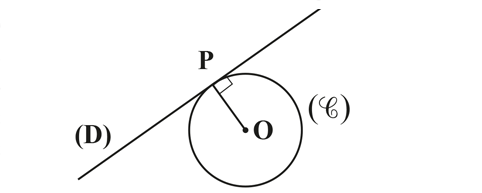
The simplest definition of tangency in geometry involves a circle and a line. In the usual Euclidean plane, a line (D) and a circle ( ) may have two, one or no points of intersection. If they have exactly one point in common, they are said to be tangent. Denoting this point by P and the center of the circle by O, the line (OP) is perpendicular to (D).
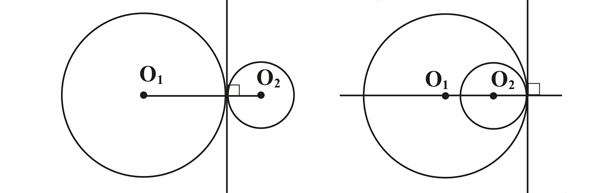
Two circles are tangent to each other if they are tangent to the same line (D) at the same point. The line joining their centers is perpendicular to (D).
Consider two intersecting lines. The center of a circle tangent to both lines lies on one of their angle bisectors, and its two points of tangency are equidistant from the intersection of the lines.
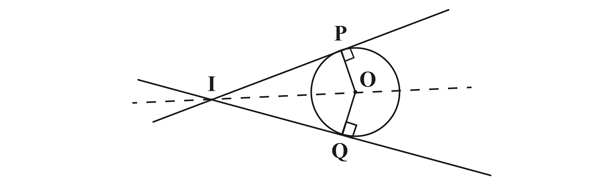
The right triangles OPI and OQI have two sides of equal length. Their third sides therefore have equal lengths as well, so IP = IQ. Consequently, since the two triangles are similar, the angles and are equal.
The incircle, tangent to all three sides of a triangle
--------------------------------------------------------
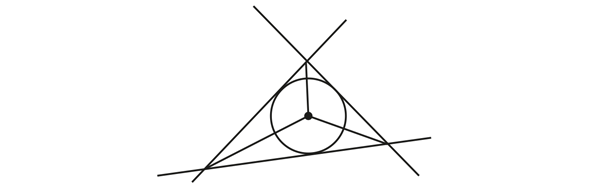
Three lines, no two parallel and not all passing through the same point, form a triangle. The triangle's three internal angle bisectors meet at a single point. As noted above, this point is the center of a circle tangent to all three sides of the triangle: the incircle.
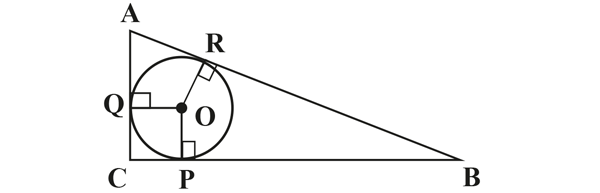
For a right triangle, an elegant formula relates the radius of the incircle to the lengths of the triangle's sides.
We have:
c = AR + BR = AQ + BP = (b ‒ r) + (a ‒ r), from which we obtain 2r = a + b – c (here, a (respectively b, c) denotes the length of the side opposite vertex A (respectively B, C)).
More generally, the area S of a triangle is related to its side lengths and the radius r of the incircle: 2S = r (a + b + c).
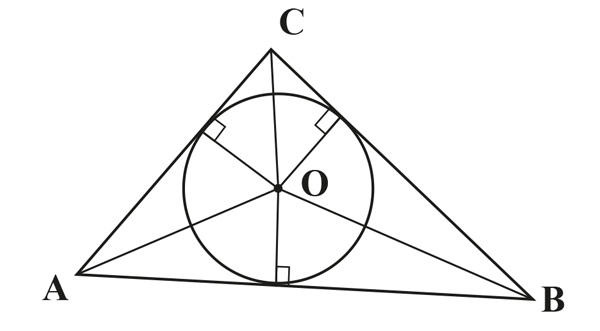
To prove this, simply add the areas of the three triangles OAB, OAC and OBC.