-
She now teaches in northern Essex at a school serving students aged 11 to 18. Since the summer of 2018, she has been posting geometry "puzzles" on Twitter: small, colorful, hand-drawn illustrations presenting geometry problems. These bright, shimmering miniature artworks rival both the famous Japanese sangaku from the Wasan period (see "The beautiful geometry of sangaku") and the first six books of Euclid's Elements, reimagined by Oliver Byrne in 1847 (Taschen, 2022 for the latest edition).
Often accompanied by a question asking the reader to calculate an area or an angle, Catriona Agg's figures provide very little information. This is often puzzling at first glance—and contributes to the elegance of the problems.
The online response was immediate: many people around the world began avidly following the young teacher's posts, each contributing a solution, a comment, a new suggestion or a generalization. Catriona Agg's imagination seems boundless! A slim book collects her earliest creations (Geometry Puzzles in Felt Tip, or "Geometry puzzles in felt-tip pen," Independently Published, 2019).
A major educational benefit
-----------------------------
When Catriona Agg is asked why she began creating her puzzles, she first mentions her love of geometry and coloring, and above all the visual nature of the problems. She says that her mind is full of images and that she likes explaining things with diagrams. She especially likes how engaging these little problems are: they look more inviting and less "mathematical" than an algebra question.
Activities built around these charming drawings help instill a few fundamental principles in her younger students: everyone can improve at mathematics by learning from their mistakes; thoughtful ideas matter more than quick answers; and thinking well means asking lots of questions. Agg's aim is precisely to start with an image and prompt questions and encourage the search for generalizations or invariants. Algebra is often highly effective, of course, but it is not always necessary: even the youngest students can solve some problems by being clever, looking at the figure from another angle or cutting it up differently… Non-trivial results lie hidden behind the simplest figures, and discovering them brings surprise and delight.
There is no doubt that Catriona Agg's students and audience benefit from her smile and infectious enthusiasm for mathematics!
Pencils at the ready!
---------------------
As in Japanese sangaku, Catriona Agg's puzzles often feature circles tangent to one another. Here are a few examples for you to enjoy, highlighting both the mathematical and artistic dimensions of her work!
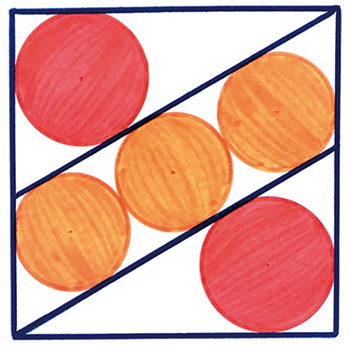
Five circles lie inside a square.
The two red circles have a total area of 24.
What is the total area of the three orange circles?
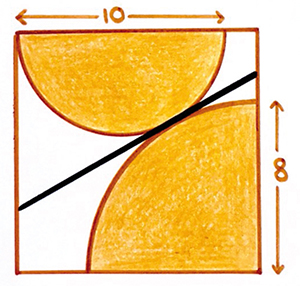
A semicircle and a quarter-circle
lie inside the square.
What is the length of the black line segment?
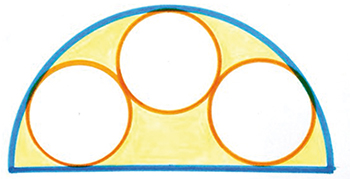
What fraction of this semicircle is not covered by the three white disks, which all have the same diameter?