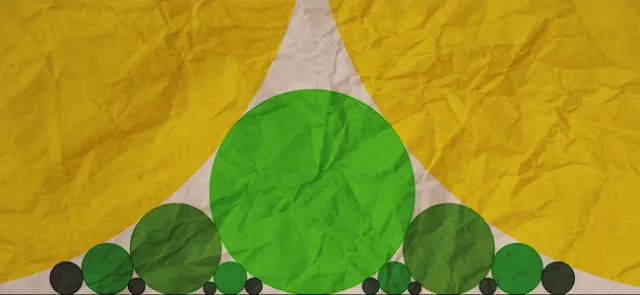
Strange tablets hung at the entrance of certain Buddhist or Shinto temples in Japan during the Edo period (1603‒1867). There, one could find a geometric puzzle to solve. These are the famous sangaku (literally, "mathematical tablets"). Some nine hundred sangaku have come down to us or have been documented.
The geometric problem posed is often a genuine challenge—not because of the knowledge required, but because of the complexity of the solutions, which sometimes run to several pages!
The aesthetic aspect is never neglected: colors are used, and the engraved figures generally reflect an exquisite sense of harmony or elegance. The idea of tangency is omnipresent in the sangaku.
Little knowledge required
--------------------------
What fascinates amateur (and professional) mathematicians about the sangaku is how little knowledge they require: the Pythagorean theorem is a must, as are the triangle similarity criteria. The law of sines (see box), computing areas, solving quadratic equations, and the notion of inversion with respect to a circle are also useful. It is difficult, however, to know how these notions were understood by the Japanese mathematicians of the time.