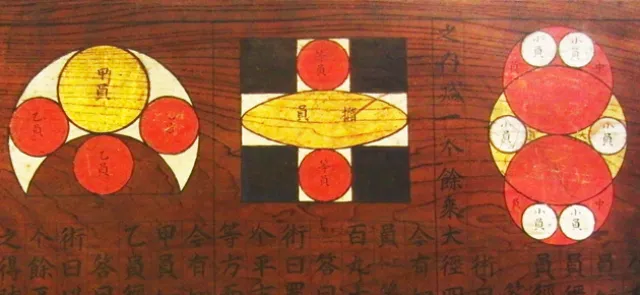
For nearly two centuries, painted wooden tablets depicting geometry theorems could be seen hanging in Japanese temples and shrines. These tablets, illustrated with highly aesthetic figures and known as san gaku, were offered to the gods by mathematicians or their students, but sometimes also by ordinary people.
A country turned in on itself
---------------------------
In 1635, the government of the shogun, the powerful feudal lord who then held the mikado, emperor of Japan, under his tutelage, forbade any Japanese subject from traveling abroad on pain of death. Four years later, in 1639, to counter the efforts of Christian Jesuits seeking to evangelize the country, this same government severed all relations with Portugal and Spain, which had long traded in the region. Only the Dutch and the Chinese were allowed to continue their trade relations with Japan, on condition that their ships dock at an artificial island off the port of Nagasaki (Kyushu). Moreover, the number of foreign ships permitted each year was drastically restricted.
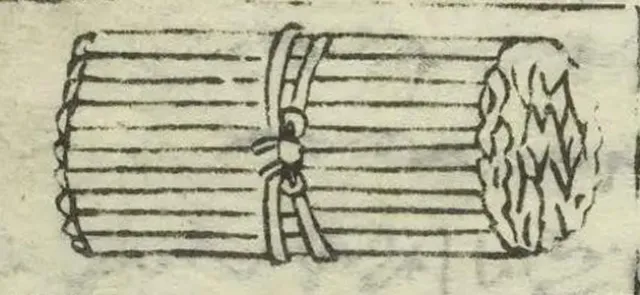
For most of the period that followed, known as the Edo period (1603–1867) — Edo being the former name of the city of Tokyo — Japan remained turned in on itself, almost entirely cut off from the rest of the world. Books, and mathematics books in particular, stopped entering the country. Only a very few foreign treatises had managed to reach Japan by then, the most important being the principal work, written in 1261, of the Chinese mathematician Yang Hui (c. 1238–1298), which would be translated into Japanese in 1661 by Seki Takakazu (c. 1640–1708).
Apart from the influence of this 13th-century work, Japanese mathematics developed in isolation for more than a century and a half. This mathematics, known as wasan, is very different from that of the Western world. It takes the form of a catalog of algorithmic procedures for solving a large number of problems step by step. In devising these procedures, Takakazu conceived the beginnings of what would become the theory of determinants. He also worked on methods for accelerating convergence and on Bernoulli numbers.