



Sangaku
The Japanese votive tablets found at the entrance of certain temples have long interested mathematicians because they sometimes contain elegant geometric puzzles, where circles play an important role. Their resolution is easy when it requires no particular result. More often, one must appeal to classical theorems, such as the Pythagorean theorem. Finally, in some rare cases, the problem posed has resisted for centuries… One cannot imagine it: the last puzzle was only solved in 2020! Welcome to the world of sangaku.
All articles in this folder
Geometry theorems
With the country cut off almost entirely from the world during the Edo period, Japanese mathematics developed in isolation for more than a century and a half. It was during this period that highly distinctive geometric puzzles flourished and prospered.

The last two sangaku solved | Tangente
Of all the sangaku on record, two have proved particularly difficult to solve. The Japanese mathematician Yamaguchi Kanzan (c. 1781–1850) collected them in his travel journal between 1817 and 1828.

The golden ratio in sangaku
Though Western in origin, the golden ratio is said to be everywhere. So we went looking for it in sangaku… and struggled to find it, except in a few rare figures. But perhaps we simply overlooked it!
Geometric puzzles at infinity
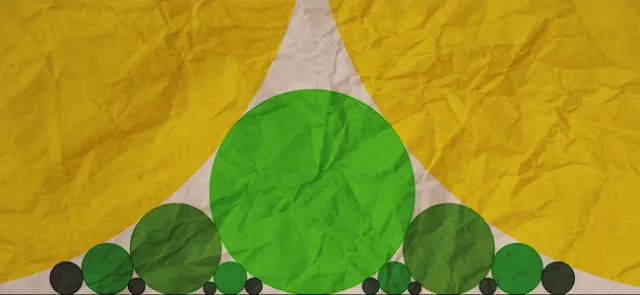
Some of the most famous sangaku figures echo other mathematical constructions, forging beautiful connections between results established in different places and at different times. Here is a particularly striking example.