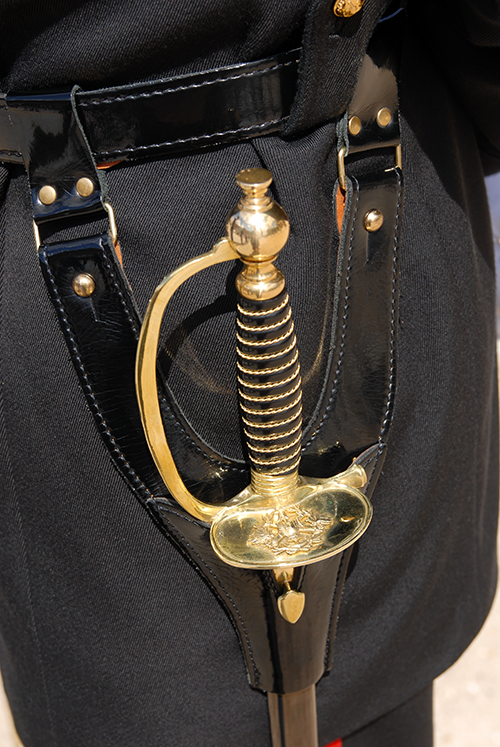
The Code X is a collection of tongue-in-cheek rules drawn up by students to uphold the institution's traditions and honour. It warns "that the light-hearted way in which they are presented to you should not make you forget their serious side". In it, an upperclassman addresses a new recruit: "Do you see the upperclassman? You cannot fail to recognise him by his noble, proud bearing and the stylishness that sets him apart […]. His confident gaze crushes the civilian; his body is upright and his chest luxuriant. On his left he wears the sword that, tangent to the stripe, touches the ground and sends dust flying." Hence, by metaphor, the name tangent given to the sword, which has only one point of contact with the body.
At the start of the academic year, the upperclassmen toss the new recruits' swords together into a heap: this is the tangent salad. Each student must retrieve his own, in return for a contribution to the student fund!
From the 19th century onwards, the École admitted a number of foreigners from distinguished families as external students. With no uniform and therefore no sword, these students "with zero tangent" were naturally called constants. Famous "constants" included the Russian military men Nikolai Rimsky-Korsakov (1844–1908), inspector of the Imperial Russian Navy's bands, and Eduard Ivanovich Totleben (1818–1884), the celebrated defender of Sevastopol against… the French!
The composer Rimsky-Korsakov had sound-colour synesthesia, which made him perceive musical notes as coloured, while General Totleben's name ("death-life" in German) is an oxymoron and the antonym of the pleonastic pun "slain-dead."