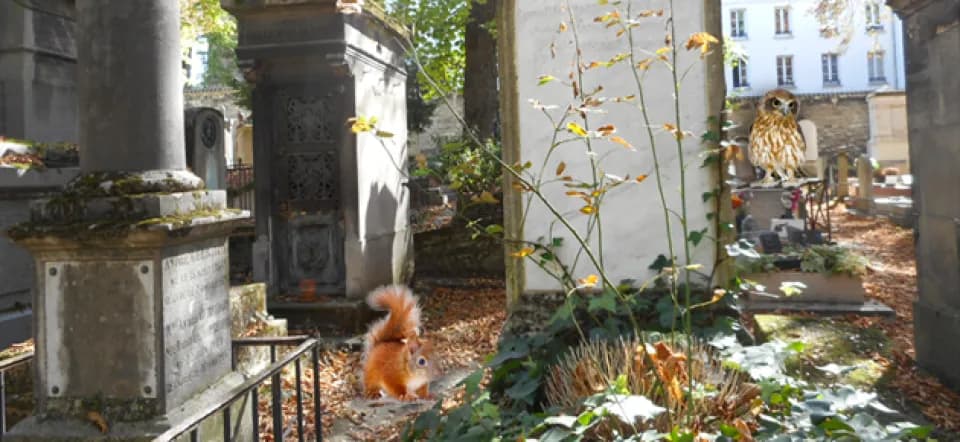
With its 4,000 trees spread across more than forty-three hectares, Père-Lachaise Cemetery is the largest green space within Paris proper. It is also an open-air museum of art and history. Its more than 70,000 graves include an almost unbelievable number of famous figures from every field: literature, poetry, architecture, painting, music, film, the performing arts, politics, the military, science... It is also a major tourist attraction, drawing two million visitors a year. Groups of tourists wander along the cemetery’s paths. Tour operators and guides offer a wide range of themed tours, since the necropolis is so vast that seeing everything in a single day is impossible. Yet one theme seems to be missing: science. So here is a tour of the mathematicians of Père-Lachaise.
Louis Poinsot
-------------
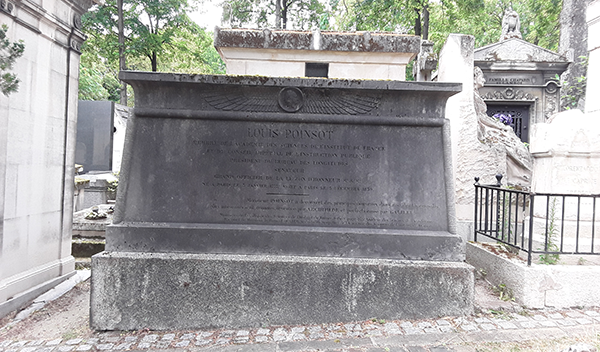
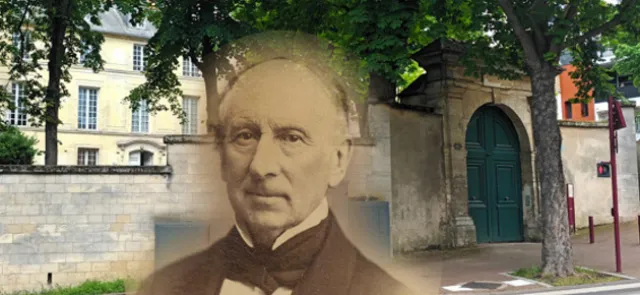
The first mathematician on our tour, near the main entrance on Boulevard de Ménilmontant, is Louis Poinsot (1777–1859), who came last in the entrance examination for the first class of the École polytechnique. He later became a professor there, as well as a member of the Académie des sciences and the Bureau des longitudes, a senator and a peer of France; his name is inscribed on the Eiffel Tower. Among other achievements, this illustrious geometer discovered two non-convex regular polyhedra. His grave stands on the left of the main avenue, in the 4th Division. He is in good company: nearby are the cenotaph (\*) of Gioacchino Rossini (1792–1868) and the grave of Alfred de Musset (1810–1857). Baron Hausmann lies just a little farther up, while the great astronomers François Arago (1786–1853) and Jules Janssen (1824–1907) rest on the other side of the avenue.
\* A cenotaph is a tomb-like monument that contains no body.