




Proportionality and geometry
This issue is not fully translated into English yet; only translated content is shown.
Read the French versionAll folders in this issue

Proportionality and geometry
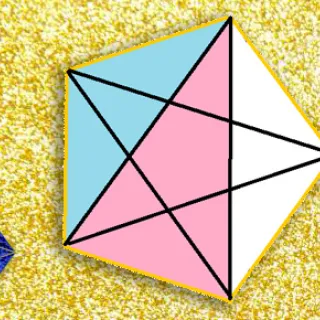
From the beginning, proportionality, which is found in algebra with the rule of three, has become essential in geometry. It is encountered to prove the incommensurability of certain lengths or to evaluate areas and volumes. In Euclid, it is an indispensable tool for many proofs. Very closely linked to parallelism configurations, through the famous Thales theorem, it gave rise to famous results, such as Ceva's or Menelaus' theorems. Less known, antiparallelism and the associated ratios opened the way to new approaches. We owe to them the power of a point with respect to a circle or the inversion transformation.

Spaces to discover
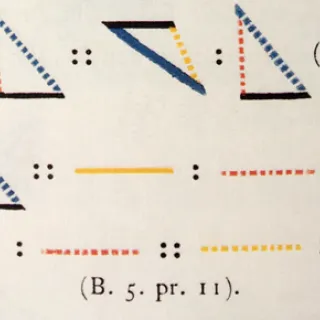
Hilbert spaces, Banach spaces, normed vector spaces, topological spaces, measurable spaces... Conceptualized at the end of the 19th century and the beginning of the 20th, spaces are indispensable to the work of today's mathematician. We can imagine them as 'working environments' that provide 'tools' (distances, norms, scalar products, measure...), allowing us to formalize the notions involved in solving problems (convergence, limit, continuity...). We then discover that ideas initially appearing on sets of numbers or vectors can apply to more complex sets, like spaces of functions. A small guide to find one's way in spaces.


All articles in this issue

Death of Pierre Cartier (1932–2024)
Nicolas Bourbaki himself announced it in "Le Carnet" in the September 1–2 issue of Le Monde: the group "pays tribute to Pierre Cartier, who died on August 17 and was a contributor to and voice of the group for many years. A wide-ranging, voluble and mischievous mathematician (he announced Bourbaki's death forty years ago), he leaves behind a rich and varied legacy."

Alexandre Grothendieck, mathematics' rebel legend
On the Radio France website, the programme "Les grandes traversées" explores the lives of people who embarked on momentous journeys, whether literal, political or intellectual.

Integer polygons
The discovery that so simple a figure as a square cannot have both sides and diagonals of integer length troubled several great scholars of antiquity. Can polygons with this property nevertheless be found? This seemingly innocent question continues to open up new avenues of research today.

Italo Calvino's mathematical writing
Widely read in Italian schools and universities, Italo Calvino is a major author, renowned for the literary quality of his work. He was also an avid lover of mathematics and readily drew on it in his writing, particularly to structure his texts, as one would expect of a committed Oulipian.

Daniel Litt's probability problems
The young mathematician Daniel Litt currently holds a position at the University of Toronto. His research usually explores the interplay between algebraic geometry and arithmetic. Yet in recent months, he has attracted attention in an entirely different field, even earning an interview with the renowned online publication Quanta Magazine.
The mathematicians of Père-Lachaise
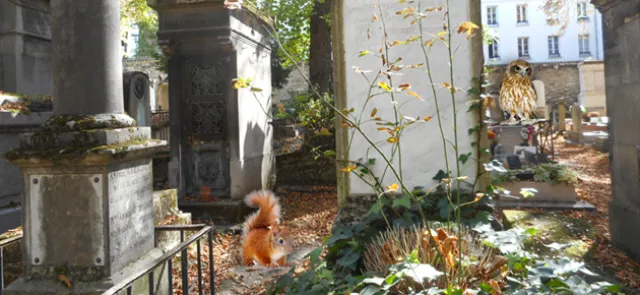
At this time of year, around All Saints’ Day, tradition calls for visits to cemeteries. So let's take the opportunity to visit the graves of mathematicians in the most iconic cemetery of all: Père-Lachaise.