



Proportionality and geometry
From the beginning, proportionality, which is found in algebra with the rule of three, has become essential in geometry. It is encountered to prove the incommensurability of certain lengths or to evaluate areas and volumes. In Euclid, it is an indispensable tool for many proofs. Very closely linked to parallelism configurations, through the famous Thales theorem, it gave rise to famous results, such as Ceva's or Menelaus' theorems. Less known, antiparallelism and the associated ratios opened the way to new approaches. We owe to them the power of a point with respect to a circle or the inversion transformation.
All articles in this folder
Rediscovering proportionality
Proportionality often brings to mind the rule of three—in other words, a method of calculation. Yet the concept first emerged in geometry, through the study of similar figures, a cornerstone of many theorems that gave rise to the idea of incommensurable quantities.
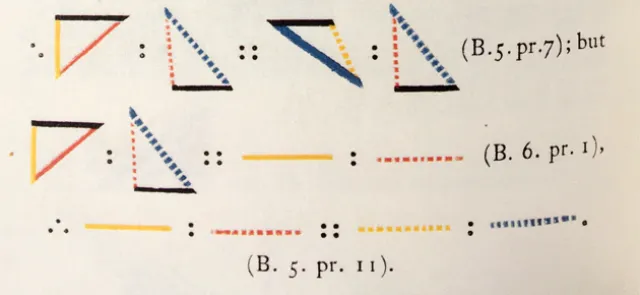
In Euclid's work
Ancient geometers struggled to handle ratios of lengths or areas that were not necessarily commensurable, because they could not conceive of irrational numbers. The definition found in Euclid's Elements remained in use until the 19th century.
Thales’ children
Many proofs in elementary geometry rely on proportionality. Almost all of geometry’s classic theorems involve it: Thales, Ptolemy, Menelaus, Ceva, Pappus… Here is a brief tour of these great problems.
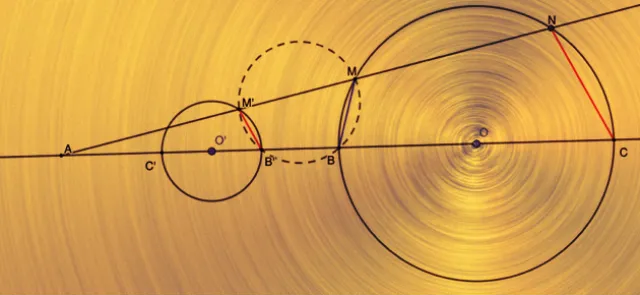
The curiosities of antiparallelism
In elementary geometry, proportionality often involves parallel lines, through the intercept theorem. But there are also antiparallel lines. Might there likewise be such a thing as "antiproportionality"?