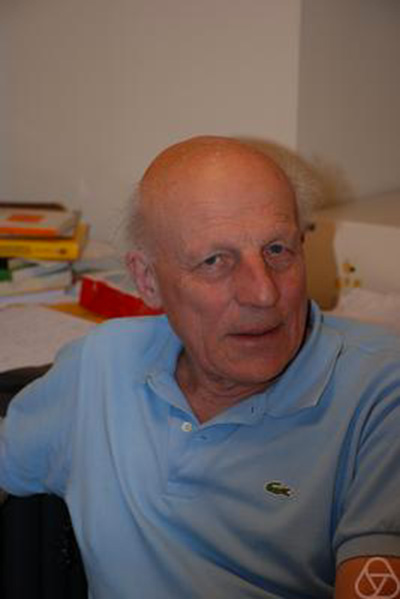
This enthusiastic French mathematician was one of the mainstays of the Bourbaki group, founded in 1935 and known for recasting mathematics in a new form. Through his involvement from 1955 to 1983, and especially his talks at the Bourbaki seminar, Pierre Cartier brought advances in the various branches of mathematics to the attention of knowledgeable enthusiasts.
His name lives on in several areas of algebraic geometry through the Cartier divisors or the Cartier operator. A man of immense learning who always had an anecdote to share, he knew how to engage his audience; wherever he went, he guided his students and colleagues alike. After initially serving as a professor at the Université de Strasbourg, he became a research director at the CNRS, from which he was seconded to the IHÉS (Institut des hautes études scientifiques), then to the École polytechnique and the École normale supérieure. To everyone who knew him, he was a "gifted communicator of mathematics."
Mathematician without borders
----------------------------
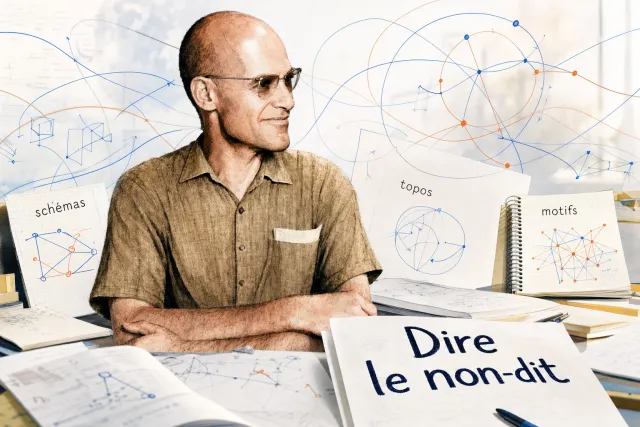
A researcher at the IHÉS from 1971 to 1982, Pierre Cartier remained closely connected with the institute thereafter. Many saw him as continuing Alexandre Grothendieck's influence within the IHÉS. The two had met through Bourbaki in the late 1950s and became friends. The institute's website features a series of tributes from mathematicians, both colleagues and others, who encountered Pierre Cartier throughout his career (**www.ihes.fr/pierre-cartier-fr**).
He often said, "Borders are made to be crossed," and meant it both literally and figuratively. Pierre Cartier travelled to many countries as a member of the Centre international de mathématiques pures et appliquées (an organization created by UNESCO to promote mathematical research in developing countries), giving courses and seminars. In mathematics, "do not be afraid of wild ideas" was one of his guiding principles, as he showed throughout his research by daring to forge connections between different fields. Always happy to share his thoughts in conversation, he is recognized as the source of many ideas later developed by other mathematicians.