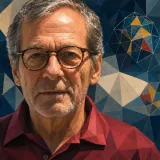
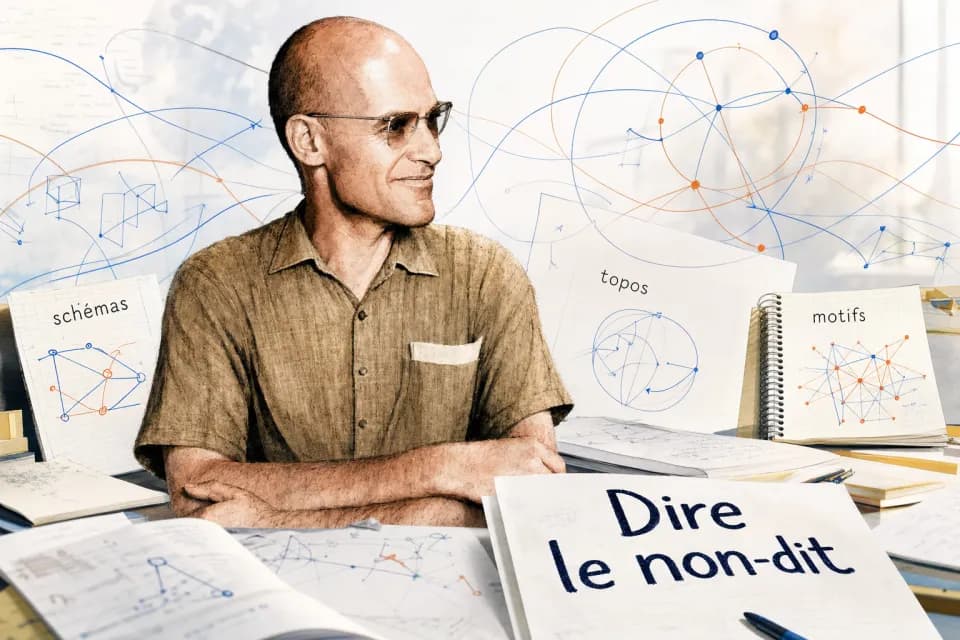
Alexandre Grothendieck is recognized as a mathematical genius. Yet we should not forget that his mathematical practice was intimately bound up with an aesthetics of language: giving voice to the unspoken, whether in mathematical concepts or human relationships.
Out in the Wild West of mathematics, when legend is more beautiful than reality, legend prevails. So it is with the legend of Alexandre Grothendieck. Countless books have been devoted to him, and we will not attempt the impossible task of summarizing them here. We simply wish to focus on a few details within this vast canvas, looking for moments in his unceasing search for a language.
A childhood steeped in the unsayable
Grothendieck's childhood was already a search for a name. Born Alexander Raddatz in Berlin in 1928 and named after his mother Johanna Grothendieck's partner, he became Alexander Grothendieck-Raddatz before taking the name Alexander Grothendieck. Stateless in France, he later adopted the first name Alexandre when he became a French citizen. His legal and biological father's surname was Schapiro, a Jewish name that Alexandre never bore in Nazi Germany. His father was killed at Auschwitz, probably in late 1942.Before the Second World War, his mother had written a vast autobiographical novel, Eine Frau ("A Woman"), which Alexandre often used as an aide-mémoire for his childhood. In La clef des songes, Alexandre quotes his mother's cry: "I can do whatever I want." This unfinished attempt at autobiography, which Alexandre himself judged rather harshly, may have remained both a negative model and an encouragement to write.
Moving from foster home to group home through the darkest years of the century, Alexandre recalled his first encounters with languages in Récoltes et Semailles: "There was the magic of numbers and words, symbols and sounds, and also of rhythms [..] Rhythms seemed to contain a mystery that went beyond words […] There was a time when I spoke only in rhythm."