



Mathematics and language _ a moving boundary
Language and mathematics have a complex relationship that neither philosophy nor neuroscience has managed to establish. Some thus imagine that mathematics is a language among others. It is from this perspective that Leibniz worked on a universal language modeled on algebra which would allow, in addition to mutual understanding for all, to establish, through a "calculation", the truth of stated propositions. Neuroscience, for its part, teaches us that at the cerebral level, mathematics constitutes, for the brain, a distinct semantic system, independent of natural language and rooted in universal numerical and spatial intuitions. The question of the relationship between mathematics and language remains, in the age of artificial intelligence, completely open.
All articles in this folder
 Podcast
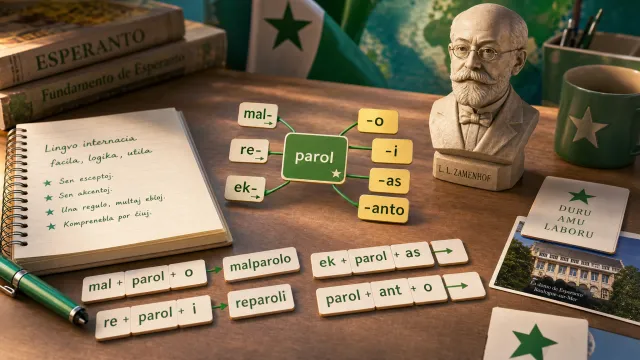
Esperanto and mathematics: a coherent universal language
Esperanto, created by Zamenhof in 1887, shares mathematics’ ideal of perfect coherence. Discover why this constructed language fascinates logicians and mathematicians.
 Podcast
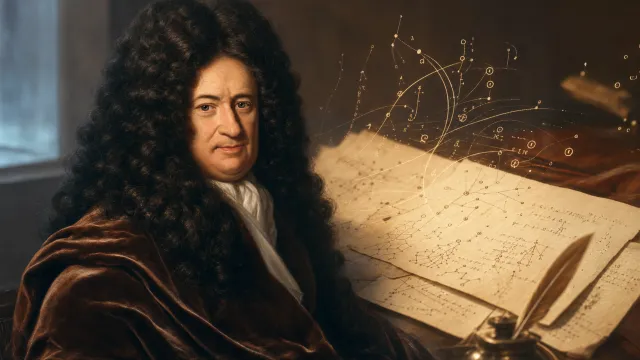
Did Leibniz really invent the ancestor of the computer?
The article dispels the myth of Leibniz as a forerunner of the computer by examining the historical reality of his universal-language project.
 Podcast
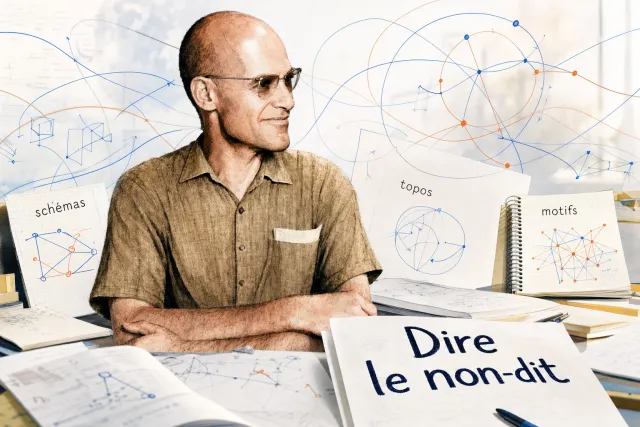
Alexandre Grothendieck: the quest for mathematical language
A portrait of Grothendieck, a mathematical genius whose practice was intimately bound up with an aesthetics of language, from schemes to topoi.
 Podcast
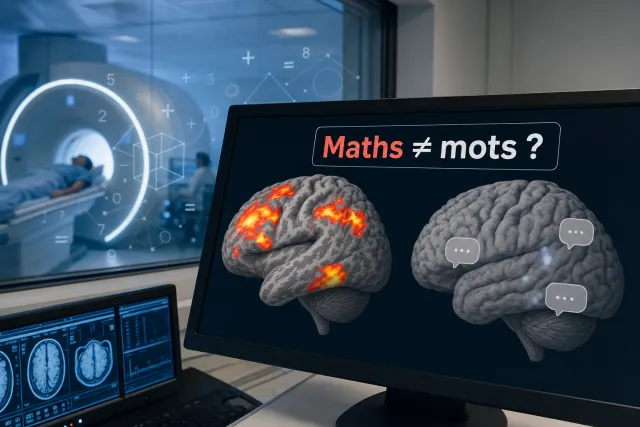
Do you think in words when solving an equation?
Neuroscience reveals that the brain processes mathematics through networks distinct from those of natural language, calling into question our understanding of mathematical cognition.