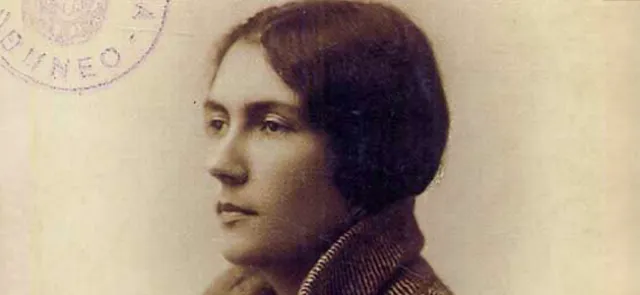
Esperanto and mathematics share a common ideal: to build a coherent system, free of exceptions and ambiguity, in which every rule applies universally. Believing that most conflicts arose from misunderstanding, Dr Louis-Lazare Zamenhof (1859–1918) dreamed of creating Esperanto in 1887, a language so easy that anyone, with even a minimal education, could learn it and use it actively.
Esperanto is built from a small number of basic elements (sixteen grammatical rules, lists of roots, suffixes and prefixes), which can be combined endlessly according to fixed principles. Its logical structure, designed to make it easier for beginners to remember, appeals to mathematicians.
Nouns end in "o", adjectives in "a", verbs (in the infinitive) in "i", and adverbs in "e". Hence the words varmo ("warmth"), varma ("warm"), varmi ("to be warm") and varme ("warmly"). And there are no exceptions to this rule!
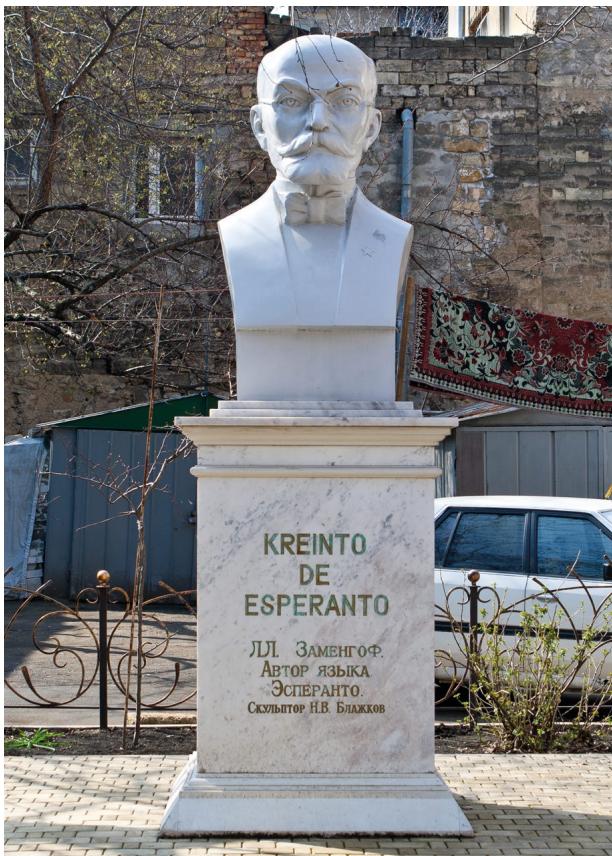
Bust of Louis-Lazare Zamenhof in Odesa, Ukraine. © 123RF / elec
How words are made
In Esperanto, a single root generates an entire network of words by adding suffixes or prefixes, which can themselves be combined.
"Bird" is birdo. Adding a suffix to the root bird yields a host of other concepts: birdino ("female bird"; -in- marks the feminine), birdeto ("small bird"; -et- marks the diminutive), birdego ("large bird" or "big bird"; -eg- is augmentative), birdejo ("aviary, a place where birds live"; -ej- denotes a place), and birdisto ("bird keeper, someone who looks after birds"; -ist- denotes an occupation). Suffixes can also be combined: birdistino is a female bird keeper. This is only a small sample of the many possible transformations!
The prefix mal- is highly mathematical. It works like an inversion operator applied to any adjective: bona ("good") gives malbona ("bad"), granda ("large") gives malgranda ("small"), and varma ("warm") gives malvarma ("cold").
This system is perfectly regular and applies to any root without exception—something no natural language can claim.