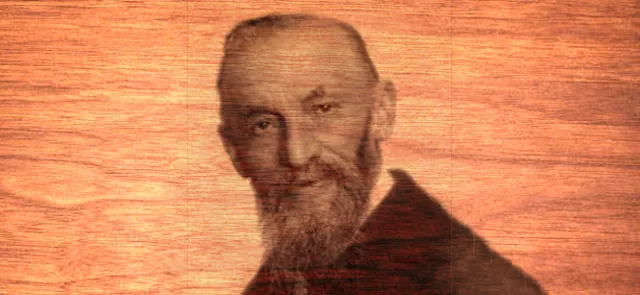
The Italian mathematician Giuseppe Peano (1858–1932) left behind a rich and varied body of work. The most fascinating part of it is the curve that bears his name, the first example of a continuous curve that "fills" a surface. Introduced in 1890 in the short article Sur une courbe, qui remplit tout une aire plane (written in French, even though the article appeared in the prestigious German journal Mathematische Annalen), this curve is one of the earliest examples of what are now called fractal curves. At the end of the four pages, Peano connects his work to that of the German mathematician Georg Cantor (1845–1918) on the fact that a line segment and a square have the "same number of points," meaning that the two can be placed in one-to-one correspondence.

Three iterations of the Peano curve.
Traces of Peano
-----------------------
Peano's name also comes up when learning the principle of induction or thinking about the properties of the set of natural numbers. The most fundamental of these properties are now known as the "Peano axioms," following a 36-page publication (this time in Italian), Arithmetices principia nova methodo exposita, dated 1889. Through this work, he left a lasting mark on logic and on thinking about the foundations of mathematics.