




This issue is not fully translated into English yet; only translated content is shown.
Read the French versionAll folders in this issue

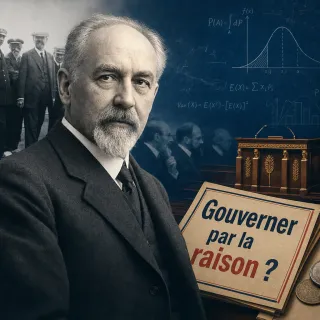
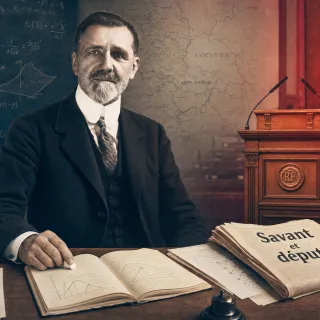
Émile Borel, the Scholar and the Statesman
Mathematician, committed politician and influential member of the French intelligensia, Émile Borel alone embodied the ideal of the "Republic of Professors". From Dreyfusism to the Resistance, via the Popular Front and the early days of European construction, he conducted scientific research and civic struggle side by side, convinced that the same rational rigor governs science and politics. His work on measure and chance — notions whose mathematical depth far exceeds intuition — laid lasting foundations, from Lebesgue's theory to normal numbers. The latter, whose strangeness the writer Jorge Luis Borges seemed to have foreseen in his fiction, still open up unexpected horizons today, from ergodic theory to computer science.
Mathematics and language _ a moving boundary
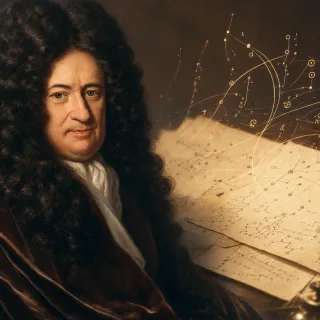
Language and mathematics have a complex relationship that neither philosophy nor neuroscience has managed to establish. Some thus imagine that mathematics is a language among others. It is from this perspective that Leibniz worked on a universal language modeled on algebra which would allow, in addition to mutual understanding for all, to establish, through a "calculation", the truth of stated propositions. Neuroscience, for its part, teaches us that at the cerebral level, mathematics constitutes, for the brain, a distinct semantic system, independent of natural language and rooted in universal numerical and spatial intuitions. The question of the relationship between mathematics and language remains, in the age of artificial intelligence, completely open.
All articles in this issue
 Podcast
Making algebra audible with the CubeHarmonic
Invented by Maria Mannone, the CubeHarmonic uses a Rubik's Cube to create musical harmonies and teach algebra intuitively.
 Podcast
Educational playing cards in the 17th century
In the 17th century, Joseph Moxon and his son James published educational playing cards for learning astronomy, geometry and the art of carving.
 Podcast
The 2026 Tangente Prize awarded to Roger Mansuy
The 2026 Tangente Prize was awarded to Roger Mansuy for his Grand almanach mathématique, at the Salon culture et jeux mathématiques in Paris.
 Podcast
The SMF prizes
The Société mathématique de France awards its 2025 prizes to the exhibition “Ça résonne” by MMI Lyon and to the company L'île logique, along with the ResCo scheme for collaborative teaching.
 Podcast
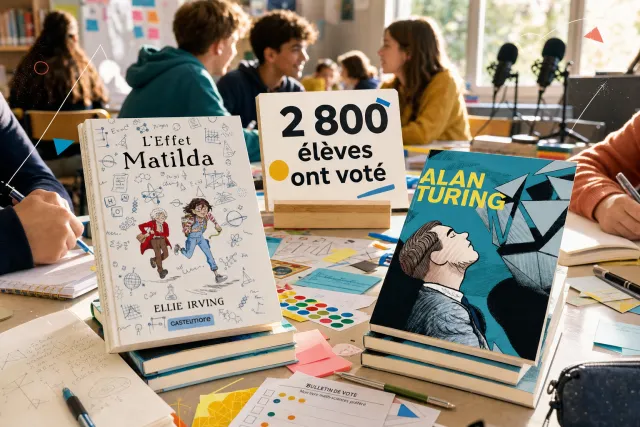
The results of the Tangente Prizes for middle and high schools
The winners of the Tangente Prizes for middle and high schools are known. Nearly 3,000 students voted for their favorite mathematics books.