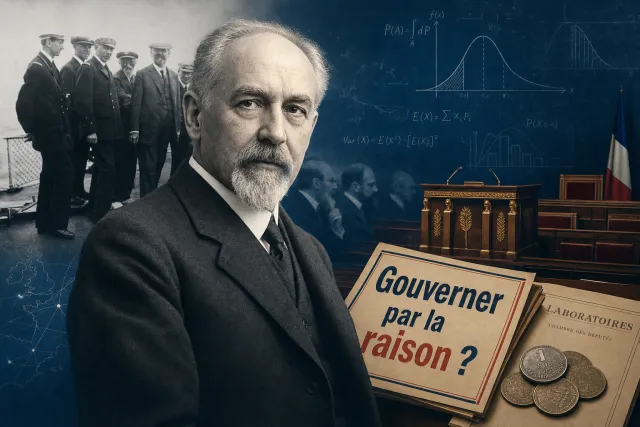
Émile Borel was at once a mathematician who dominated the academic world of his time, a man who entered politics late in life but remained committed to it thereafter, and a member of the intellectual elite through his friendships and his marriage. He was representative of what was then called the "Republic of Professors."
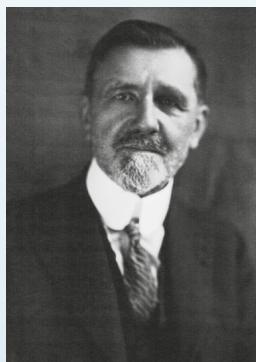
Émile Borel in 1929. © Bnf
Émile Borel was born on 7 January 1871 in Saint-Affrique, a small town in the Aveyron, into a small Protestant community then led by the pastor Honoré Borel, his father, who had married a daughter of major cloth merchants from Montauban. Émile was educated at the private Protestant school run by his father, then continued his studies at the Lycée Ingres in Montauban, before joining the Lycée Louis-le-Grand in Paris for the classes préparatoires, the intensive courses that prepare students for France's elite grandes écoles; he ranked first in the entrance examinations for both the École polytechnique and the École normale supérieure, and chose the latter. In 1892, he ranked first in the agrégation in mathematics, then earned a doctorate in mathematics in 1894. He was appointed lecturer at the Faculty of Sciences in Lille in 1893, then in Paris from 1897.
Before he turned twenty-five, he published twenty notes in the Comptes rendus de l'Académie des sciences and about ten more in the leading university mathematics journals, on function theory, the definition of measure, probability theory, game theory, and mathematical physics.