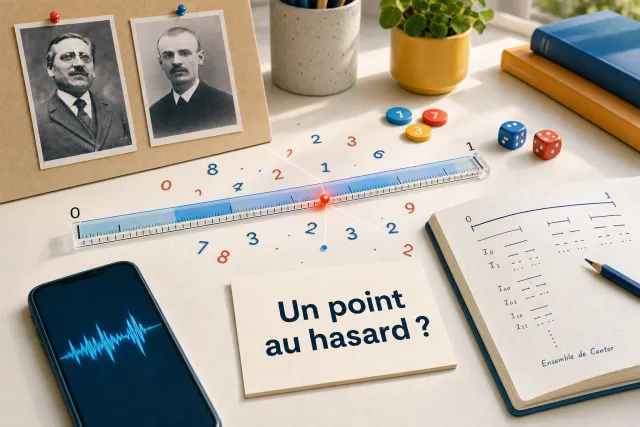
The definition of normal numbers given by Émile Borel can be understood by reading La Bibliothèque de Babel (The Library of Babel) and Livre de sable (The Book of Sand) by Jorge Luis Borges. Their astonishing properties open onto measure theory, ergodic theory, and even computer science.
The Argentine writer Jorge Luis Borges (1899-1986) tells us that the Library of Babel contains every possible book, including those yet to be written. In much the same way, a normal number contains every imaginable sequence of digits: it holds your phone number, the password you haven't created yet, and even an encrypted version of that message you've been waiting for so long. In other words, a normal number is an infinite library of digits. This definition covers both the frequency at which each individual digit appears and that of any block of digits.
The definition of normal numbers is due to Émile Borel (1871-1956), who introduced it in 1909 in a paper published in the Rendiconti del Circolo Matematico di Palermo (Proceedings of the Palermo Mathematical Circle), titled Les probabilités dénombrables et leurs applications arithmétiques (Countable Probabilities and Their Arithmetic Applications). In this work, to which we will return shortly, Borel draws fundamental connections between measure theory, probability, and number theory.
Babel, sand, and Borel
How big is the Library of Babel, and how many volumes does it hold? The library's books can be counted if each volume can be matched with a natural number: 0, 1, 2…, all the way to infinity. In another of Borges's stories, however, there is the Book of Sand, whose pages resist any such count: it was impossible to leaf through, because infinitely many others would slip in between any two pages, the pages themselves dissolving into a multitude of fragments like grains of sand. These pages were uncountable, since they could not be placed in one-to-one correspondence with the natural numbers. Just like the pages of the Book of Sand, the set of real numbers in mathematics is said to be uncountable. Integers, too, are infinite, but a sharp line separates them from one another, just as it does between the pages of a... normal book.