-
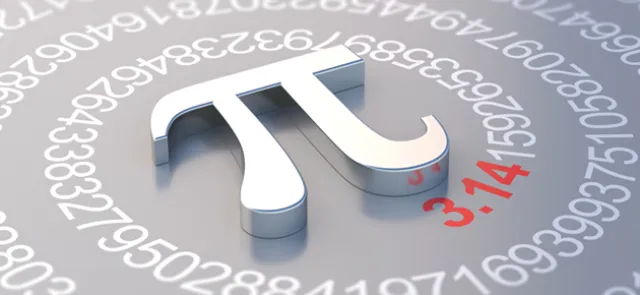
In decimal notation, a rational number has either a finite decimal expansion or one that eventually becomes periodic, as in . The irrational number , by contrast, has infinitely many decimal places, with no apparent pattern.
If all the digits in a number written in base 10 are uniformly distributed, meaning that each occurs, on average, once every ten places, the mathematician Émile Borel, one of the fathers of probability theory, calls the number simply normal in base 10. More generally, if sequences of k digits, for every k, occur on average once every 10*k, the number is called normal in base 10. A number normal in every base is said to be absolutely normal or, simply, normal*.
In 1909, Émile Borel proved that the real numbers without this property, although uncountably infinite in number, form a "set of measure zero." Hence the term "normal," since "almost all" real numbers are normal. This leads to the apparent contradiction that the probability of drawing a "non-normal" number at random is zero, even though there are infinitely many of them!