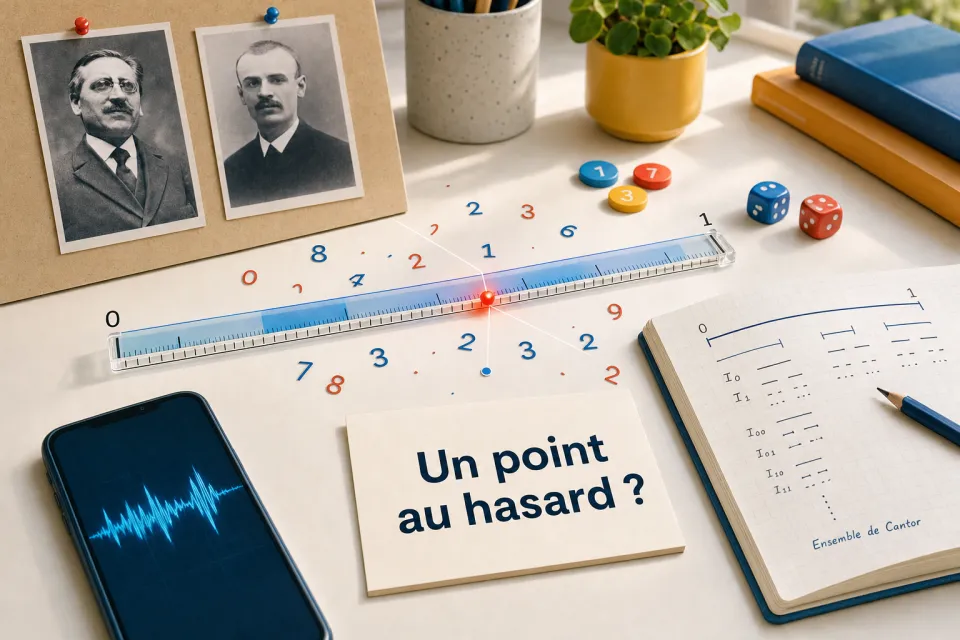

Measure and chance are notions that seem commonplace, but whose mathematical definition is far more complicated and far broader than intuition suggests. This is clear from Lebesgue measure, Borel's normal numbers and the Borel conjecture.
Can one pick a point at random on a line segment? How does one do this, and how can this operation be used? What exactly is an arbitrary subset of a line, or of a plane? Advances in mathematics forced these questions on researchers at the very beginning of the twentieth century. Émile Borel was at the forefront of the challenge. Our story begins in Greece, where the Ancients — contemporaries and even predecessors of Plato — practiced geometry, in particular the calculation of areas and volumes and the drawing of tangents. One name stands out: Archimedes, born around 287 BCE and died in 212 BCE at Syracuse, one of the greatest scholars of Antiquity. He carried out impressive calculations of area and volume using the method of exhaustion, the forerunner of infinitesimal calculus.
Not until the seventeenth century did two exceptional researchers, Isaac Newton (1642–1727) and Gottfried Leibniz (1646–1716), discover a deep and unexpected link between areas and tangents: the corresponding calculations are inverse to one another! Today's high-school students know that the antiderivatives of a function are precisely the functions whose derivative is . Integral calculus and differential calculus are thus two sides of the same coin. This fundamental discovery gave rise to classical analysis. This Newtonian calculus (the term used in English for differential calculus) applies to countless situations, but it is of course only one step. In the early years of the nineteenth century, Joseph Fourier (1768–1830) laid the foundations for the theory of the function series that bear his name, indispensable for modeling wave phenomena such as sound or light. It was precisely while solving a problem concerning the convergence of Fourier series that Georg Cantor (1845–1918) discovered the complexity of closed subsets of the line, which led him to create set theory. Émile Borel (1871–1956) belonged to the following generation, directly influenced by Cantor's work. Together with his juniors and students Henri Lebesgue (1875–1941) and René Baire (1874–1932), he formed the triumvirate of founding fathers of modern function theory, which we will now sketch out.
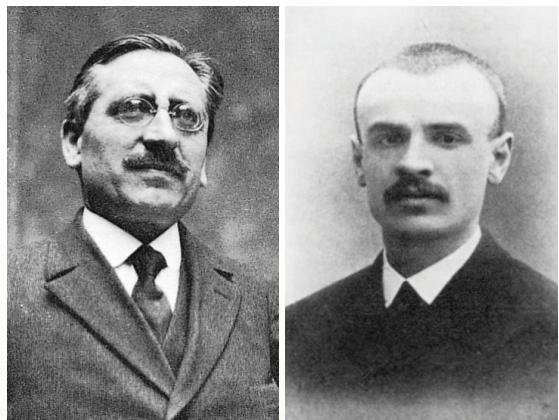
Henri Lebesgue and René Baire. (c) PD-Art