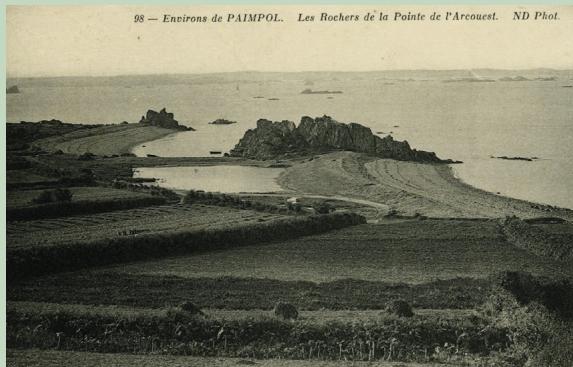
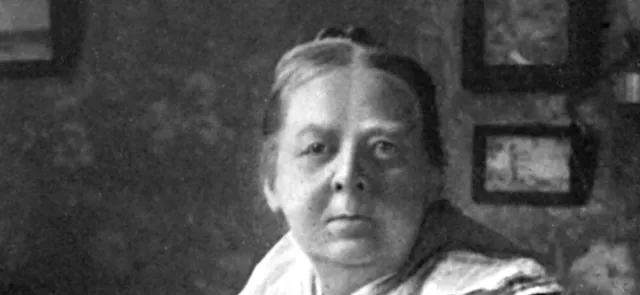
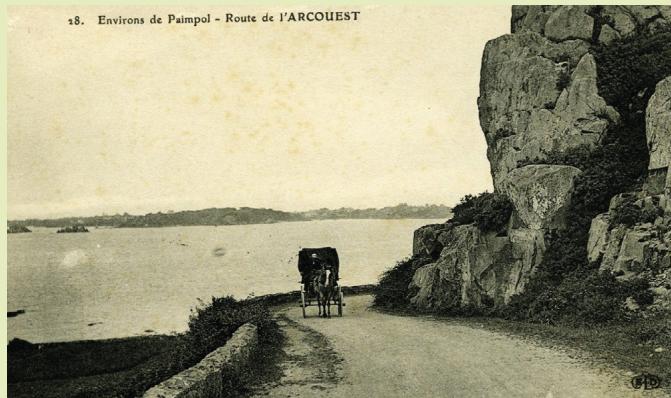
The Arcouest peninsula, near Paimpol, had become a regular holiday retreat for many academics, including the Borel family.
Intellectuals by the sea
As a child, Marguerite Appell became familiar with Arcouest while her parents were staying in Kérity, a suburb of Paimpol. They would visit the historian Charles Seignobos, who shared a house on the nearby Arcouest peninsula with Louis Lapicque's family; together, they welcomed many visitors passing through. Another gathering place for Parisian scholars was the home of the philosopher Baptiste Jacob, a native of Kérity and a teacher at the écoles normales in Sèvres and Fontenay. He was a friend of Marie Curie, Perrin and Seignobos, as well as of Gabriel Koenigs, professor of mechanics at the Sorbonne, who himself served for a time on the Kérity municipal council. Not far from Paimpol, in Port-Blanc, lived Anatole Le Braz, professor of history at the University of Rennes and a renowned folklorist, and Léon Marillier, professor of the religions of non-civilized peoples at the École pratique des hautes études; they too welcomed academic friends passing through. Lapicque had attended Marillier's lectures, and Marillier's mother was Seignobos's partner. Port-Blanc was also a family holiday destination for the chemist Victor Auger and the historian and École normale alumnus Georges Pagès, both future members of the Arcouest circle.
The Arcouest circle
Although the Borels spent most of the summer in Saint-Affrique, they made frequent visits to Arcouest. Émile Borel would stop off at Arcouest on his return from Brest, where he served as an examiner for the École navale entrance examination. When Seignobos acquired his own house in 1910—a large house designed to accommodate guests—the Borels had a room reserved for them. Seignobos, known as "the Captain," was assisted by Cécile Marillier, "the Little Mother"; he was the driving force behind the place and organized its activities and festivities. Around 1910, Perrin, who had also come to administer the École navale entrance examinations, paid his first visit to Seignobos. He became one of the Arcouest regulars. Two other École normale alumni, also close to the Borels, later joined the small colony: the geophysicist Charles Maurain and his wife, Jeanne. As sociable as her husband was retiring, she was a talented pianist, spoke English well and was close to Perrin, whose student she had once been. She became one of the leading figures in what had become the Arcouest circle, an exclusive, elitist club that recreated and broadened one of the hubs of Parisian intellectual and academic life.
Marie Curie's arrival in the Arcouest circle in 1911 and 1912 rounded out the original group. A vibrant communal life bound the group together, initially around Seignobos, his house and his boat, and later—particularly from the mid-1920s onward—around Perrin. Borel's close ties with the Arcouest community helped anchor him intellectually and politically. Fond of matching wits with his friends and shining in serious conversation, Borel developed or consolidated some of his intellectual and political convictions there.
The pioneering women
Women were numerous at Arcouest and were prominent figures in these emerging social groups. After a solid university education, many joined the ranks of the "emancipated women" and women who were the first in their fields: the first women to earn doctorates or the agrégation, the first women doctors, the first women to hold various university posts and the first to attain political office. Finally, within this community of secularists, agnostics and atheists, there was a strong inherited Protestant culture—from Seignobos to Pagès and Borel—and an educational system partly shaped by it: full coeducation, an emphasis on sports and outdoor activities, the creation of a parent-run school cooperative, and later the enrollment of a number of the younger generation at the Collège Sévigné or the École alsacienne.