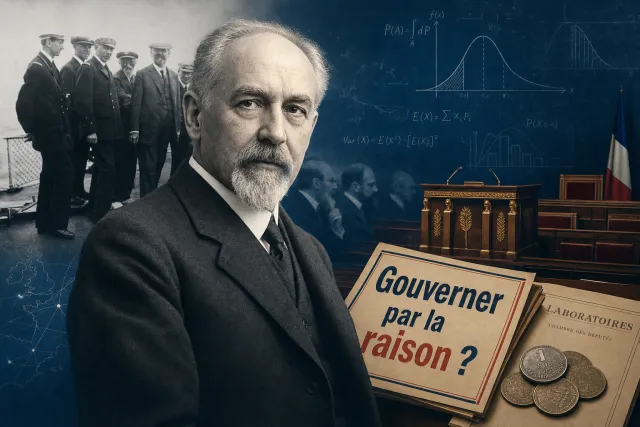
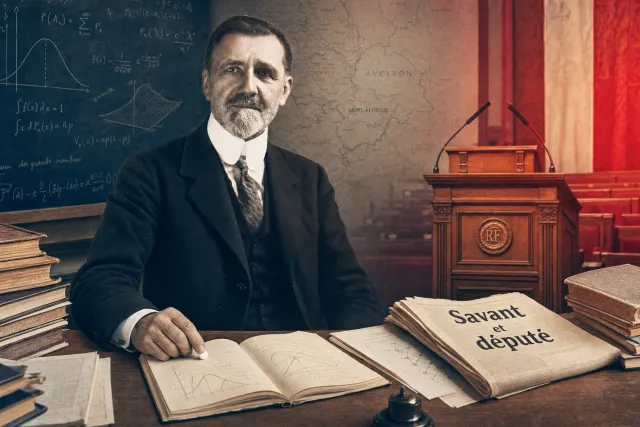
Borel's commitment to science, to Europe and to politics more broadly was built on arguments and reasoning. Here are a few of them.
On 22 August 1925, Borel published an article entitled "The organization of scientific research" in La Revue scientifique. In it, he made the case for stable, long-term funding of research: "The need to organize disinterested scientific research, to draw toward it some of the most distinguished among the young, is inescapable. (…) I shall confine myself to pointing out one of the main difficulties of this rational organization of scientific research. (…) The great difficulty is that no one is able to distinguish, among the work currently being carried out by mathematicians, physicists and chemists, which of it will have an immense impact. (…) I would place my trust in a flexible and varied solution, one that would consist in designating various bodies — academies, universities, associations such as ours, renowned scholars who have proven themselves, laboratory directors — and providing them with the means necessary to encourage those among the young who seem to them worthy of it. (…) If the Society decides to make the necessary effort for young people devoted to scientific research, if each year a certain number of them are given the means to pursue the studies that interest them, it will happen that one in a hundred, or one in a thousand, of these young people will be an Ampère, a Pasteur, a Pierre Curie or a Henri Poincaré, and the material and moral benefits obtained from that one alone will repay a hundredfold everything spent on the others."
On 15 April 1927, Borel signed an article in Le Monde nouveau in favor of European cooperation. Here are its opening lines: "The idea that closer cooperation among the peoples of Europe is essential — not only to Europe, but to humanity as a whole — is nothing new to readers of this review. The difficulties Europe faces as a result of the Great War are far from over, and one may believe that our continent will find its balance and be able to reclaim the place in the world that was so long its own only if, renouncing its traditional quarrels, it finally resolves to pursue a policy of European union and concord. If it fails to do so, one cannot but think that Europe will cease — and very quickly — to exist from an intellectual point of view, as was the case for ancient Greece."
In 1924, the following appeared in Le Radical: "Will the democratic parties once again take up the leadership (sic) of the world, or are they doomed to disappear, crushed between socialist parties with revolutionary leanings and nationalist parties with conservative leanings? This question, put forward by a French deputy — a learned deputy, Mr Émile Borel — sets out in a few words the direction of the politics championed by the Union nouvelle, and gives a precise aim to the propaganda it wishes to organize. We shall comment on it in a word: it is the European politics of the golden mean; therefore, the politics of balance." By 1937, Borel had moved from radicalism to liberalism: "While it is desirable to do away with certain inequalities and injustices that offend morality and reason, it is not desirable to reach absolute equality of wealth; the spirit of individual initiative is a factor in progress that will remain necessary for a long time, if not forever. (…) In this way, capitalism, combined with an appetite for risk, brought great benefits to the whole of humanity for a century."