In the late 17 century, Joseph Moxon and his son James published educational playing cards designed to teach astronomy, geometry and even the fine art of carving meat. These cards allowed future sailors, architects and engineers, among others, to learn while having fun!
The son of a printer, Joseph Moxon (1627–1691) set up his business in London in 1648, after returning from the United Provinces, where he had acquired advanced skills in printing and instrument making. He initially published religious and political works; at some point, however, he "began to apply himself to mathematical studies", as he would later write. In a remarkably short time, Joseph Moxon established himself as an outstanding maker of maps and scientific instruments, as well as a publisher highly regarded by the scientific elite.
He corresponded with major figures such as
Robert Boyle (1627–1691) and Edmund Halley (1656–1742), and regularly discussed his publications with his friend Robert Hooke (1635–1703). As evidence of his immense standing, he was appointed hydrographer to the King in 1661 and, in 1678, became the first—and only—tradesman to be elected a Fellow of the prestigious Royal Society.
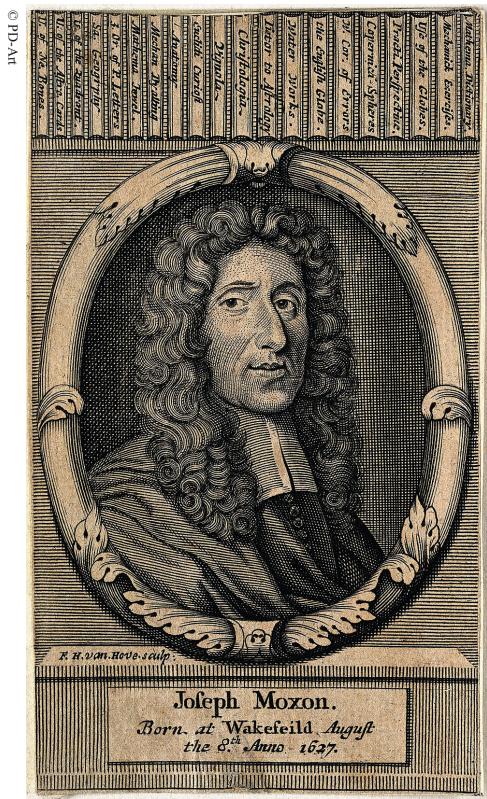
Engraving of Joseph Moxon.
The catalogue of Joseph's business perfectly reflects both his connections with the Royal Society and his desire to hold an honorable place among English gentlemen, as well as his belief that knowledge should be accessible and intelligible to practitioners.
His famous series of Mechanick Exercises (1677–1683) offered readers the "doctrine of handicrafts", ranging from "smithing" to "printing": the volumes were intended for practitioners, but they also seem to have answered the Royal Society's desire for a written catalogue of the mechanical arts. The Mathematicks Made Easie: or a Mathematical Dictionary (1679), by contrast, was expressly designed by Joseph Moxon for beginners and young students, as he states in the preface; in practice, however, artisans and manual workers could also benefit from it.