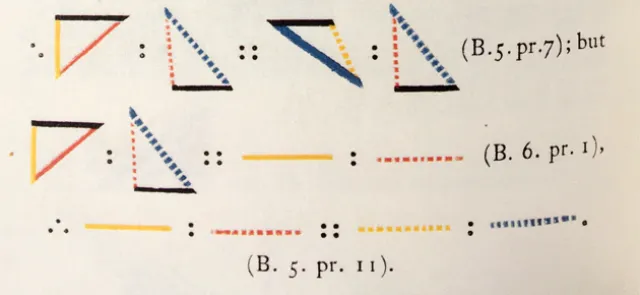
If four pens cost €2.42, how much do fourteen pens cost? This question comes from a television program that set out to test the education minister at the time. He had to admit that he did not know the answer... The presenter’s solution was first to "find the unit price," calculating that a single pen costs 2.42 / 4 = €0.605, then multiplying by 14 to obtain the answer: €8.47. This is an application of the famous rule of three, which is based on the principle of proportionality. Monge and Guinchan’s venerable 1959 textbook for ninth grade defines them as follows: "Two quantities are proportional if, when the measure of one is multiplied (or divided) by 2, 3, 4, ..., the corresponding measure of the other is multiplied (or divided) by 2, 3, 4, ...". In our problem, the two proportional quantities are the number of pens and their total price. Euclid put it slightly differently: the ratios between two measures of the same quantity are equal to the ratios between the corresponding measures of the other. Such ratios are dimensionless numbers.
Using linear functions
----------------------------
A proportional relationship pairs one quantity with another. Since the 17th century, such a correspondence has been viewed as a function of one variable—more precisely, as a function that multiplies by a constant, the coefficient of proportionality. Thus, if x is the number of pens, the function f defined by f (x) = 0.605x gives the price of those x pens. Another property is clear: adding values of the first quantity—the numbers of pens—corresponds to adding their associated values—the prices.
We can plot the number of pens on the x-axis and the price on the y-axis. This produces a set of points lying on a line—or ray—through the origin.