



Fractions to observe
A frequent tendency regarding the value 1/2 is to want at all costs to write it as 0.5. The value 1/3, whose decimal expression has no end (0.333…), nevertheless offers a simple example of the superiority of fractional notation over decimal notation, at least in a mathematical context. Decimal expansion has not had its last word, however, since that of a fraction is always periodic, therefore also expressed in a finite form, even if in its own way. On the other hand, there exists a vast set of numbers, such as √2 or π, that cannot be expressed in the form a/b (with a and b integers). Despite this failure to represent all real numbers, fractions nevertheless remain a crucial tool for exploring the fundamental concept of proportionality, in which mathematical notions and school pedagogy intertwine.
All articles in this folder

Proportionality: so crucial, so difficult
Proportionality arises in problems involving multiplication, division, and combinations of the two. Because it is difficult to learn, it poses challenges for teaching and has prompted extensive research in mathematics education.
Coming to grips with decimal expansions
Like any real number—for example, pi—a fraction can be written as a finite or infinite decimal expansion. Remarkably, the resulting decimal expansion is always eventually periodic.
When fractions fail
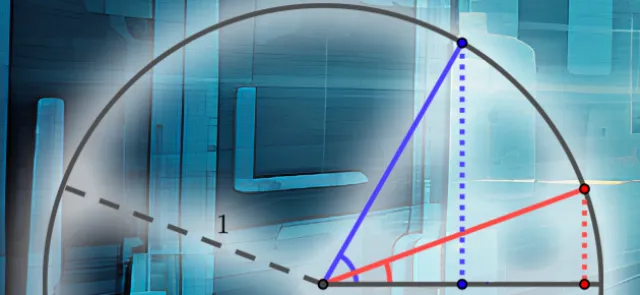
Fractions cannot do everything! The existence of irrational numbers forces us to accept that the concept of number extends beyond quotients of two integers. The reward is a new world to explore, full of surprises.

An unhurried journey to infinity
The harmonic numbers form a sequence that tends to infinity, but very slowly. That does not stop them from playing a role in several important problems.