The modern mathematics reform of the 1960s and 1970s was a major worldwide undertaking. It can be compared with the reform of the 17th century, when symbolic algebra—the algebra of polynomials and equations—entered secondary schools and universities. Just a few decades earlier, trigonometry had established itself alongside numerical tables, bolstered by the invention of logarithms, which had been unknown to Greek geometry. The logarithmic function prompted the development of the sine, tangent and other functions, which had previously been regarded as geometrically defined lengths, without reference to the sine curve. The true significance of this conceptual reform lay in the invention of numerical tables: they transformed the very idea of mathematics by making it necessary to learn how to handle approximation.
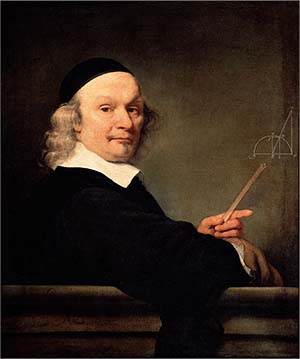
Portrait of a mathematician, by Ferdinand Bol (Louvre Museum).
These new tables were highly useful to geodesists, who used them to survey conquered colonial territories. They gave Europeans the impression that they could disregard all the mathematics developed outside Europe, including that of the older Islamic world, whose influence nevertheless remained acknowledged.
=
The revolution in integral calculus
-----------------------------------
The word "reform" is not equivalent to "revolution," a term used all too readily. Yet it is appropriate for the late 17th century, when mathematics made unprecedented and unexpected inroads into contemporary conceptions of cosmology through celestial mechanics, and of the physical world more generally. This revolution arose from differential and integral calculus, which had only a slender geometric foundation—the theory of tangents—and little logical warrant in terms of the Euclidean axiomatic system. Calculus proved extraordinarily effective in the abstract investigation of new functions, even yielding a power-series expansion for the sine function and thereby transforming the very procedure used to compile tables. In elementary mathematics—the mathematics taught in schools, where standards are needed—new "rituals" were established.
The early-17th-century reform, driven by the use of numerical tables, made fractions commonplace and introduced the very different notation of non-terminating decimals. This notation would later serve as a model for one of the secondary achievements of the revolution in differential and integral calculus: power series, handled in the same way as the geometric series 1 + x + x2 + x3 + … representing the number 1/(1 – x). The procedure can be made "visible" by observing that a / (b – c), for three positive numbers a, b and c, is calculated by multiplying a/b—with c < b, of course—by the series 1 + (c /b) + (c /b) 2 + (c /b) 3 + … The practice of using proportions thus faded away, albeit very slowly.
The portrait opposite was painted by Ferdinand Bol in the final third of the 17th century. The unidentified mathematician, who may be John Wallis, projects a sense of calm resolve. His proportional compass is folded up and, transformed into a teacher's pointer, indicates a geometric figure drawn on the board—a first in painting! The figure replaces proportions with numerical tables, although the tables themselves are not shown. Drawn in white, like chalk on a blackboard, it looks unremarkable to us: it shows the trigonometric lines as they had been explained using the unit semicircle without a chosen orientation since the late 16th century—the cosine, sine, tangent and secant. Securing acceptance for these lines as an addition to the geometric books of Euclid's Elements was a genuine reform! They had not even found their way into books of so-called "practical geometry," which dealt with various constructions while adhering scrupulously to Euclidean precepts, even in their proofs.
As an emerging science, trigonometry was not an extension of practical geometry, and it would long disrupt the organization of teaching before Euler's and d'Alembert's complex exponential made it seem an easy, if somewhat tedious, appendix to mathematical analysis. At the time, these lines came with numerical tables and therefore with measurement practices unknown in university teaching. They embodied a concept that was struggling to emerge: the function. The formulas of trigonometry are there to remind us of the circle in what might otherwise seem to concern only the right triangle.
=
Normative reform: analysis and composition
------------------------------------------
Such reactions are professional adjustments made by teachers faced with the very difficult task of presenting a unified picture of mathematics while the subject itself is changing. The elegant geometry of the triangle in the 19th century can be seen as a reaction to the analytic geometry found in 18th-century textbooks, which was itself an intelligent development of the algebraic geometry that emerged from the work of Descartes and Fermat.
Consider the Scottish mathematician Robert Leslie, who in 1822 was determined to present an elementary geometric proof in two successive parts, analysis and synthesis, while seeking to inscribe a square in a triangle that he described as arbitrary. At the time, the proportion AF:AE::FG:EB, equal to in modern notation, was expressed without symbolic notation, in keeping with the Greek tradition: "AF is to AE as FG is to EB." Leslie was indeed partly reforming notation, but without accepting anything that might amount to algebra.
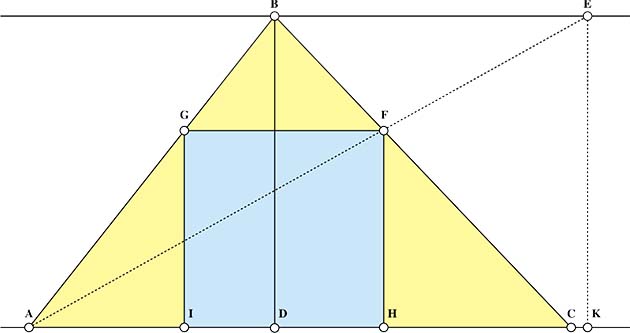
Construct a square inscribed in a triangle.
Proposition X. Let ABC be a triangle in which a square IGFH is to be inscribed.
Analysis
Join A and F, then extend AF until it meets at E the line through B parallel to AC, and drop the perpendiculars BD and EK.
Because EB is parallel to FG or AC, AF:AE :: FG:EB (Euclid's Elements, VI, 2).
And because the perpendicular EK is parallel to FH, AF:AE::FH:EK.
Hence FG:EB::FH:EK. But FG = FH, and consequently (Euclid's Elements, V, 8 and 5), EB = EK. Furthermore, since EK is equal to BD, the altitude of triangle ABC is given; hence EB is given both in position and in magnitude, and consequently the parallel FG and the perpendicular FH are given, and therefore the square IGFH is given.
Composition
From B, draw the perpendicular BD and draw BE parallel to AC; make BE equal to BD, join AE, which intersects BC at F, and complete the rectangle IGFH.
Because BE and EK are parallel to GF and FH, AE:AF::EK:FH. But BE = EK, and consequently GF = FH. Thus IGFH is clearly a square.
To foster "a fairer appreciation of the practice [cultivation in English] of mathematics," and to prepare minds for "inductive philosophy," Leslie deliberately restored the Ancients' "geometrical analysis," taking care to cite Euclid alone and, in particular, to avoid expressing proportions as equalities between fractions. His normative reform of reasoning consisted in dividing a problem into two distinct parts: an analytical part and another that he called "composition," since he did not wish to use the overworked word "synthesis." Where might Leslie have found the idea for his proof? He does not say, because his "reform" concerns how mathematics should be presented, not how new results should be discovered.
-
Geometry in China and Greece
----------------------------
The earliest surviving accounts of inscribing a square in a triangle are those of Hero of Alexandria (2nd century) and Liu Hui in China, in his 3rd-century commentary on The Nine Chapters on the Mathematical Art. In both cases, a procedure is given: for an isosceles triangle in Hero's account and for a right triangle in Liu Hui's. Each author also discusses the case in which the base on which the square is to be constructed has an obtuse angle. The Chinese text may be translated as follows.
Suppose the base is 5 paces and the height 12 paces. What is the length of the side of the square inscribed on the base?
Answer: the side of the square is 3 paces and 9 / 17 of a pace.
Procedure. Add the base and the height; this gives the divisor. Multiply the base by the height; this gives the dividend. Dividing the dividend by the divisor gives the side of the square in paces.
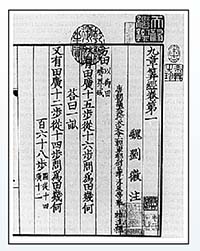
Page from The Nine Chapters on the Mathematical Art.
Interchanging the height and the base does not change the side length of the inscribed square. Only the diagram of the right triangle makes this symmetry visually apparent. Yet the proofs of these two statements are radically different! The following possible reconstruction, "in the manner of" Hero of Alexandria, will show why reform was necessary. Let us return to Leslie's diagram.
Suppose the square has been constructed. Since (GI) and (BD) are parallel, GI is to BD as AG is to AB; hence, by "division of a ratio," BD – GI is to BD as AB – AG (that is, GB) is to AB. But since (GF) and (AC) are parallel, GB is to AB as GF is to AC. Thus the difference between the height and the required length is to the height as the required length is to the base.
This result is enough to determine the required length for a Greek of the classical period, who had no notion of an algebraic formula but knew the theory of proportions. This theory, which we have forgotten, made it possible to recognize that the side length of the inscribed square is twice the harmonic mean of the height and the base! The harmonic mean M of two quantities h and b is, by definition, such that its reciprocal is the arithmetic mean 1 /h + 1 /b of the reciprocals of h and b. Equivalently, M is the third proportional to the arithmetic mean and the geometric mean, or, in our notation, bh / (b + h). There seems to be no possibility whatsoever that the geometric construction of the harmonic mean could have yielded a construction of the side of the inscribed square other than the one reported by Leslie. Expressing the square's side length solely in terms of proportions requires a two-step shift in perspective: first moving beyond proportions by introducing a little algebra, then returning to proportions. Proportions can be retained for the inscribed-square problem—but at what cost! The Chinese proof, however, is of an entirely different nature. What interests Chinese geometers is the expression for the length x of a side of the square in terms of the lengths in a right triangle: base b, height h, and hypotenuse H.
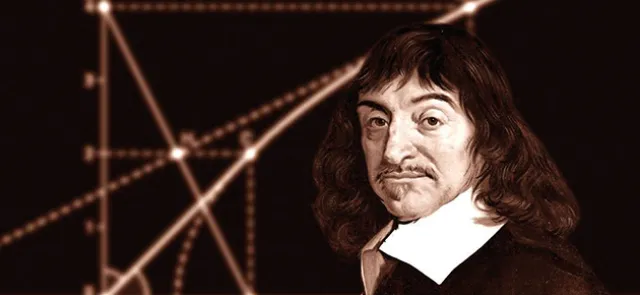
Like the computation of x using proportions, whether written algebraically or not, the Chinese procedure presupposes that the problem has already been solved before the value can be calculated and it can be proved that there exists one and only one solution. It was not until René Descartes that a line of reasoning first appeared that could certify a priori that the method used would indeed lead to a solution and that this solution would be unique. In La Géométrie (1637), he sought to identify coefficients in order to determine the tangent to a given curve. He considered a polynomial of degree 6 and explained a priori why complex roots could not arise when the method was applied. A priori, the method of undetermined coefficients solves the problem posed, so it can be applied!
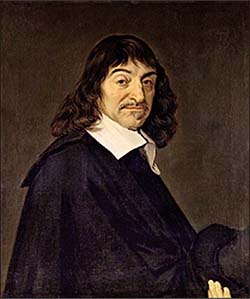
René Descartes
The example of a square inscribed in a given triangle may have served al-Khwarizmi not in inventing algebra—which would have been more than a reform!—but in illustrating how to solve a problem using an equation. In doing so, he reformed a geometric practice: he calculated the area of the triangle in two different ways, first by multiplying the base by the height and dividing by two, and then by decomposing the triangle into three smaller triangles, AGI, BFG and FCH, and a square, FGIH. The resulting formula can be used to find x because the quadratic terms in x cancel. Therein lies the power of algebra: this simplification, which is predictable if one merely thinks of it, makes the result uniquely determined rather than the product of a quadratic equation that might have two solutions. The cancellation of the squared terms reflects the linear nature of the problem.
-
Reading the past does not lead to relativism
--------------------------------------------
In the 16th century, Jacques Peletier du Mans, commenting with amusement on his reform of Euclid, delighted in seeing that the various ways of presenting mathematics did not contradict one another. Yet he also castigated the "fanatics" of the axiomatic method:
"Not one [of these geometric principles] will be found that destroys, affects or even opposes in the slightest either those preceding it or those following it. Nor do the members of this body ever conspire to ruin one another, except in some furious and maniacal person."
The "maniacs" are wedded to a ritual rather than a theory. In seeking to produce a single, impeccable text, mathematicians have constantly had to reform older works, recasting what was already known to make it clearer. This is true of the Elements: while Euclid may have set the axiomatic and otherworldly tone for many later mathematical texts, his work was continually improved, reconsidered and altered, even when historians took it up in pursuit of an ideal, original Euclid. The same is true of Nicolas Bourbaki's Éléments de mathématique of the 1950s, built on the same principle: the text had to be renewed several times. There is something paradoxical in the desire for reform when the intended text is conceived each time as definitive. The "modern mathematics" deemed excessively reformist became part of the traditional norm, and the textbooks used in the 1970s were revised, altered… This raises the question of what value there is in reading old texts, or even recent ones, once they have been replaced by new works intended to improve upon them!
No one would dream of "reforming" texts by Virgil or Aristotle, except to simplify them into selected extracts. Should we imagine such a fate for mathematical texts? Reading Leslie's passage at least helps to foster critical thinking.
Interview conducted by É. T.
*
*This text is based on a lecture given by Jean Dhombres on Wednesday, January 14, 2015, at the Bibliothèque nationale de France as part of the "Un texte, un mathématicien" series.
Jean Dhombres is a director of studies at the Centre AlexandreKoyré.