In Budapest in 1933, a group of mathematics students, including Paul Erdős and George Szekeres, used to meet regularly. One day, Esther Klein posed the following problem: given five points in the plane in general position, show that four of them can form a convex quadrilateral—that is, a polygon whose diagonals lie inside it.
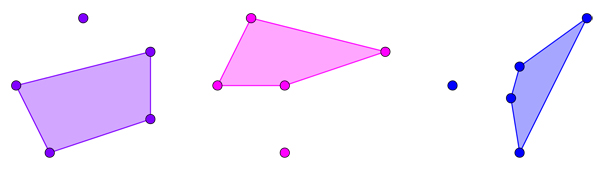
This delightful result can be proved with a little thought and a case-by-case analysis. Erdős dubbed it the happy ending problem because, among other things, it led to the marriage of George Szekeres and Esther Klein (see Tangente 172, 2016)!
The problem went on to have a more mathematical extension. Why consider only quadrilaterals? We can ask how many points must be placed in the plane in general position to guarantee finding a convex polygon with n sides among them. The case n = 5 was solved in 1935: a set of nine points is needed to guarantee finding a convex pentagon among them.

In this configuration, no convex pentagon can be formed.
As early as 1935, Erdős and Szekeres proved that this minimum exists for every integer n and is less than
Twenty-five years later, they proved that this minimum is greater than 2*n*-2 +1.
In 2005, Szekeres and his student Lindsay Peters proved that a set of seventeen points is needed to guarantee finding a convex hexagon among them. No other result is currently known.