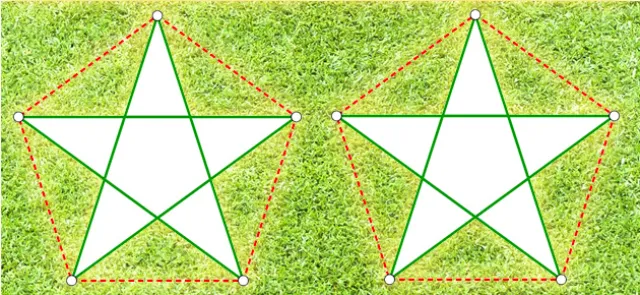
In the early 1930s, a group of young mathematicians met regularly in a Budapest park. Long before the "hacktivist" movement, they called themselves Anonymus, after a statue erected in honor of the unknown author of the Gesta Hungarorum, the earliest chronicle of Hungarian history. In 1933, Eszter Klein announced the following result to her friends in the group, including Pál Erdös, Pál Turán and György Szekeres: among any five points in the plane, no three of which are collinear, four can always be found that form the vertices of a convex quadrilateral. Szekeres then gave an existence proof for the following generalization: among a sufficiently large number of points in the plane, one can always find k that form the vertices of a convex k-gon (a polygon with k sides).
The proof is simple for k = 5: consider the convex hull of five points. If it is a quadrilateral, the problem is solved.
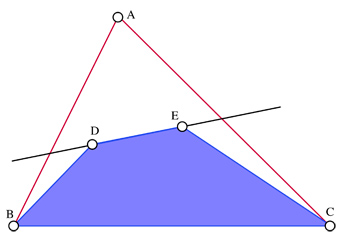
If it is a pentagon, simply remove any one vertex and the other four form a convex quadrilateral. If the convex hull is a triangle ABC, two points, D and E, lie inside it, as shown in the figure. Since no three points can be collinear, one vertex of the triangle, A, lies on one side of the line (DE), while the other two, B and C, lie on the other. The required quadrilateral is therefore BCED.
-