On 28 August 2005, George and Esther Szekeres, both brilliant mathematicians, died an hour apart. George was 94 and Esther was 95. They had been married for almost 70 years. They had met in late 1932, in Budapest, most likely in Városliget Park, where Paul Erdős regularly gathered with some twenty students. This group, which feared the first acts of repression against Jews, used these meetings to talk about politics and their personal lives. It was in these conversations that Paul Erdős began using his coded language in order to avoid spies, calling children "epsilons," women "bosses," husbands "slaves," alcohol "poison," and communists "long wavelength" (a reference to the red end of the light spectrum). These gatherings were also an occasion to talk mathematics.
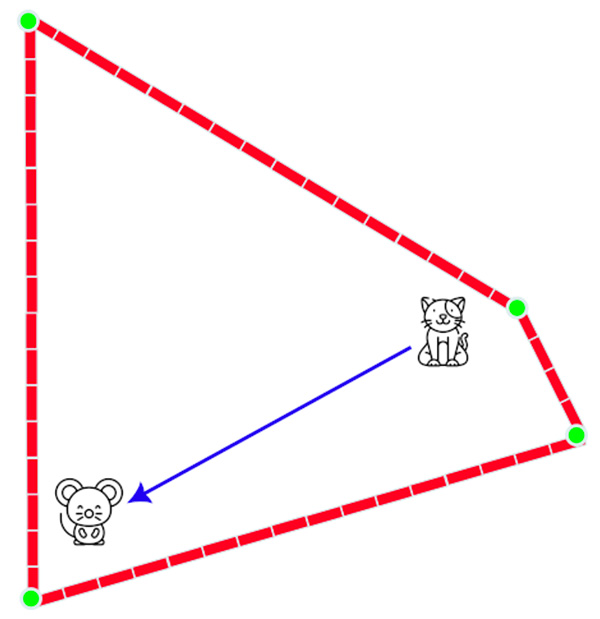
George Szekeres, a chemistry student eager to trade his test tubes for mathematics, and Esther Klein, a brilliant mathematics student, took part in these Sunday gatherings. It was at one of them that Esther posed the following challenge: given five points in the plane, no three of which are collinear, prove that it is always possible for four of these points to form a convex quadrilateral.
Epszi's Problem
--------------------
A quadrilateral is a polygon with four vertices, as the Latin prefix quadri makes clear. Squares, rectangles, rhombi, parallelograms and other trapezoids are all special quadrilaterals. The notion of convexity is a little more delicate. Intuitively, a convex quadrilateral is a four-sided polygon with no "nooks."