



Graph Problems
In the field of combinatorics, Paul Erdős's contributions have been fundamental. They enabled this discipline to reach its full scope. Much current research is based on his work to study graphs in all areas in order to, for example, model number divisors, Internet infrastructure, or epidemics. One of his innovations was to rely on probability to prove results about large sets. He was also interested in random graphs in which edges are added randomly until a certain property appears.
All articles in this folder
 Podcast
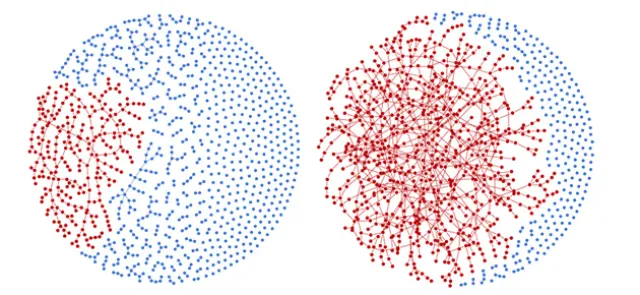
The Erdős-Rényi random graph
The Erdős and Rényi random graph model is so famous in mathematics that it has become a common noun: in probability theory, people routinely speak of "an Erdős-Rényi" the way one would speak of a Brillat-Savarin in gastronomy or a Stradivarius in music.
 Podcast
Probabilities where you wouldn't expect them! | Tangente
The probabilistic method, which Paul Erdős introduced and used, makes it possible to prove the existence of a mathematical object. Despite the use of probability, what is remarkable — and all the more surprising — is that the result obtained is certain!
 Podcast
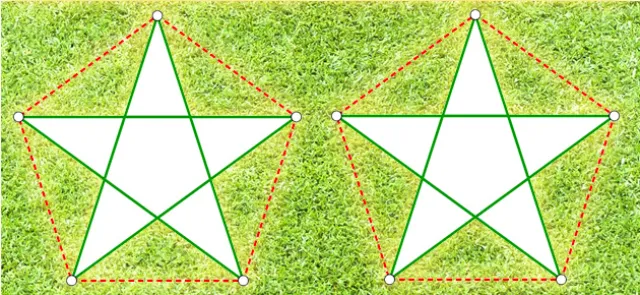
A happy ending
Behind this phrase lies a famous mathematical challenge that brought together two brilliant minds on a quest to uncover the hidden order within chaos. It was the birth of a beautiful love story — and of a new branch of mathematics!
 Podcast
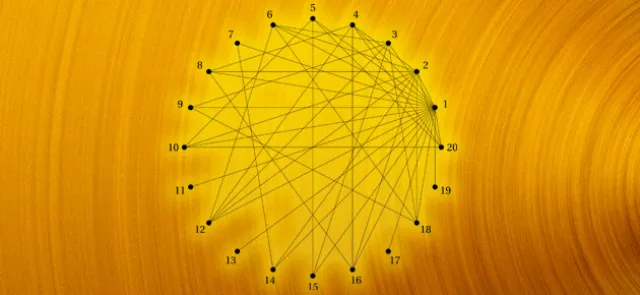
Walks in the divisor graph — Erdős and Saias | Tangente
Among Paul Erdős's interests, two fields stand out more often than others: number theory and graph theory. It is therefore no surprise that he eventually became interested in the divisor graph, a mathematical object that lies precisely at the crossroads of these two subjects.
 Podcast
Order according to Ramsey
Ramsey theory is another field in which Erdős played a crucial role without being its originator. His use of the probabilistic method was essential to this theory, whose aim is to find the size of a set that guarantees the existence of a substructure possessing a given property.