
Erdős proposed numerous problems in geometry, some of which have relatively simple statements. Here are two examples... though that does not mean they have been completely solved.
The number of distinct distances
----------------------------------
Consider a convex polygon (that is, one with no reflex angle) with nine vertices, then calculate the lengths of its sides and diagonals: this gives a set of positive numbers. In the worst case, this set contains 36 different numbers (9 sides and 27 diagonals), and in the best case, that of the regular enneagon (a 9-vertex polygon), only 4. In one of his last papers, dated 1996, Paul Erdős asked which configurations of the nine points yielded only 5 distinct lengths, and concluded that there were only two possibilities: either the nine points were chosen among the vertices of a regular decagon (a 10-vertex polygon), or they were chosen among the vertices of a regular hendecagon (an 11-vertex polygon).
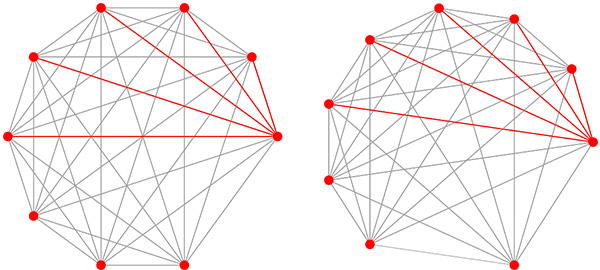
On the left: the 9 points in the decagon. On the right: the 9 points in the hendecagon.