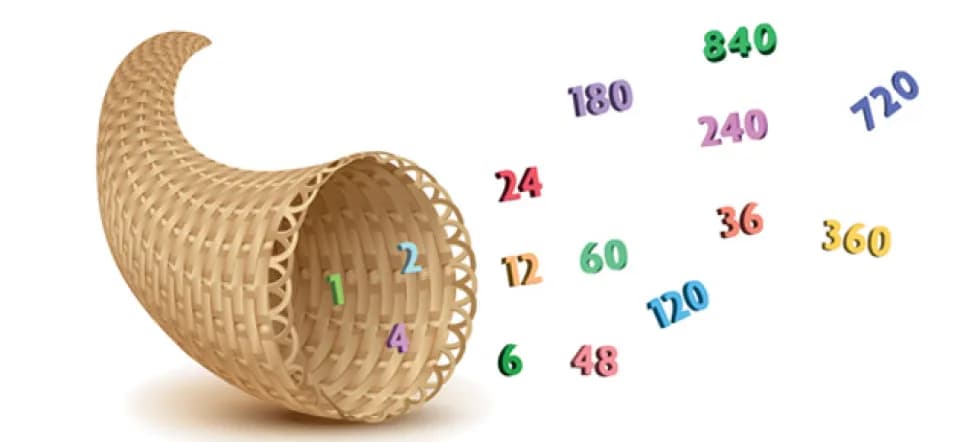
In the jungle of integers, many species can be found: prime numbers, which have always fascinated; perfect numbers, very rare; deficient numbers; and abundant numbers, among which are several families that have drawn the interest of several mathematicians, Erdős in particular.
Perfect and deficient
--------------------
A perfect number is an integer equal to the sum of its proper divisors (all the divisors of n except n itself – note that 1 is counted among the proper divisors). The first in the series are the numbers 6, 28, 486, 8128.... For example, one can check that 6 = 1 + 2 + 3;
28 = 1 + 2 + 4 + 7 + 14, and so on. At present, only finitely many are known. Even perfect numbers are linked to the Mersenne numbers *Mp = 2 p – 1 that are prime. Fifty-two are currently known. Indeed, Leonhard Euler (1707-1783) showed that every even perfect number has the form Mp (Mp +1)/2 with Mp prime, which requires that p* be prime. As for odd perfect numbers, it is conjectured… that none exist! If one were to exist, it would have to be greater than 101500 and have more than a hundred prime factors!
Deficient numbers are the integers n whose sum of proper divisors is strictly less than n. Prime numbers are all deficient, their only proper divisor being equal to 1, but they are not the only ones: for example, 4, 8, 9, 10 and 14 are also deficient numbers. There are, of course, infinitely many of them. Their density, that is, the proportion of deficient numbers among all integers, is slightly above 75%, according to a 1998 result due to the French mathematician Marc Deléglise.
Abundant numbers are the integers that are neither perfect nor deficient, that is, the integers n whose sum of proper divisors is strictly greater than n. The first are 12, 18, 20, 24, 30, 36… All abundant numbers are composite, and given the first few values, one might think they are all even: this is not the case, and 945 is the smallest odd abundant number. There are of course infinitely many abundant numbers, and their density is slightly below 25%.