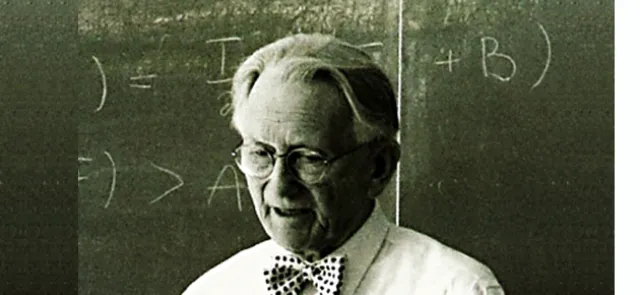
A prime source of curiosity for any number theorist is the sequence of prime numbers. An exceptional mathematician if ever there was one, Erdős was no exception on this point. Recall that a prime number is an integer divisible only by 1 and itself. The number of individuals in a group is therefore prime if it is impossible to form several teams of equal size. As such, the number 1 is not prime. There is an essential reason for this: every integer exceeding 1 can be represented uniquely as a product of prime numbers, up to the order of the factors — but if 1 were prime, an arbitrary number of factors of 1 could be added to the product, and the representation would no longer be unique.
Since the dawn of time, the structure of the sequence of prime numbers, 2, 3, 5, 7, 11, …, has intrigued humanity. There are infinitely many primes, a result already found in Euclid (circa 300 BC). The shortest proof fits in four characters: n! + 1. This integer (where n! denotes the factorial of n, that is, the product of all the integers from 1 to n) is divisible by no number less than n: its smallest prime factor therefore strictly exceeds n. Since n is arbitrarily large, we are done.
The gap between two prime numbers
----------------------------------------------
Let's leap forward three and a half millennia: the Russian mathematician Pafnuty Chebyshev (1821-1894) confirmed in 1851 the conjecture of the Frenchman Joseph Bertrand (1822-1900): between an integer greater than 1 and its double, there is always a prime number. Chebyshev's proof employed a sophisticated technique. Erdős's first paper, published at the age of 19, recovered this result with remarkable economy of means.