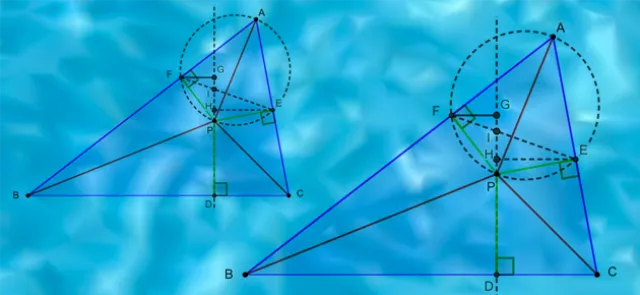
When you are inside a triangle, it is clear that you are closer to the sides than to the vertices, but by how much? In 1935, Erdős proposed the following conjecture: the average of the distances to the sides is less than or equal to half the average of the distances to the vertices, with equality only when the triangle is equilateral and the point is at its center.
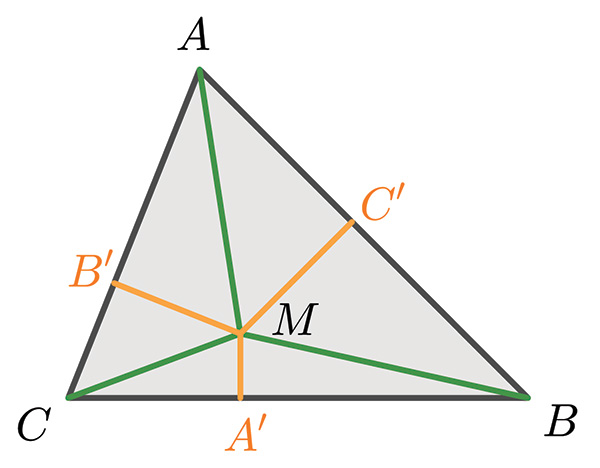
According to Erdős's conjecture, for any point M inside triangle ABC, the average (MA' + MB' + MC')/3 of the distances from M to the sides of the triangle is at most half the average (MA + MB + MC)/3 of the distances to the vertices.
For the equilateral triangle specifically, we have known since Viviani's 1649 theorem that the average of the distances to the sides from an interior point is constant. Taking as interior point M the centroid of the vertices, which coincides with the orthocenter, we can easily verify that this constant equals one third of the height. Another 17th-century result tells us that the average of the distances to the vertices reaches its strict minimum at a point called the Fermat point (the unique point that makes 120° angles with the vertices of the triangle), which, in the case of the equilateral triangle, is the same as our previous point M. By the property of the centroid, this minimum equals two thirds of the height, and so the conjecture is proved in this case.