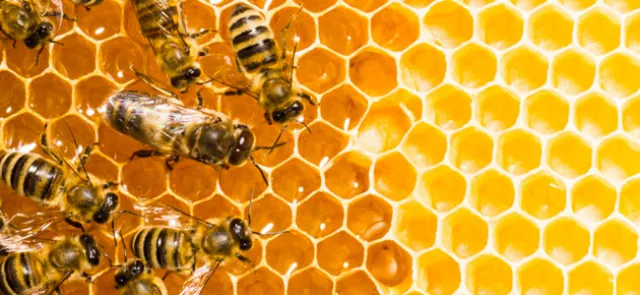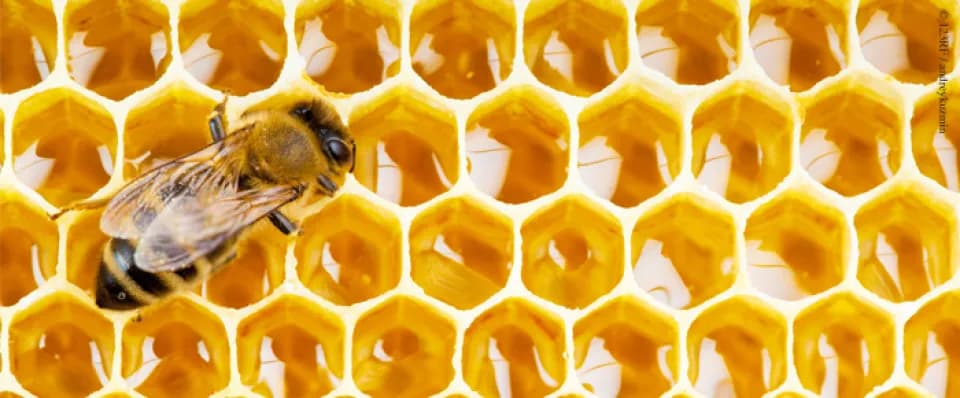
A wax comb and its hexagonal cells.
What is sometimes called a bees' "honeycomb" is actually a "wax comb," built by these insects to store their honey. Viewed from above, it reveals cells shaped like adjoining hexagons. From the side, these hexagons prove to be cross-sections of adjoining hexagonal prisms. Viewed "from the bottom," it presents the discerning eye with three rhombi arranged like the faces meeting at a vertex of a rhombohedron. Hidden within this structure are, as Emile Fourrey wrote in 1907 in his Curiosités géométriques ("Applications diverses," Chapter III), "two interesting minimum problems".
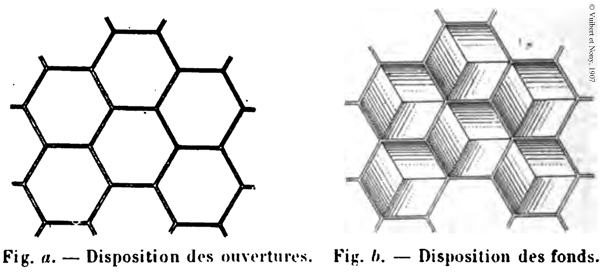
How Emile Fourrey viewed the cells.
Getting to the bottom of it
-------------------