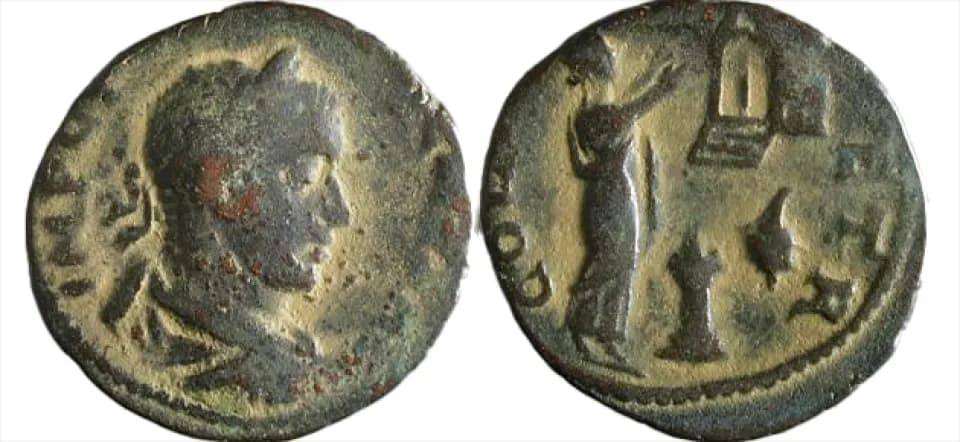
Dido's problem became famous through a few lines in Book One of Virgil's Aeneid. Aeneas, a Trojan prince, learns from Venus how the Phoenician princess Elyssa (Dido), after fleeing her murderous brother's tyranny in Tyre (in present-day Lebanon), reached the coast of what is now Tunisia and settled there.
A historical ruse
------------------
We need the commentary of the grammarian Servius (late 4th century) to understand Dido's trick: "Stranded in Libya, Dido was at first driven away by Hiarbas; she then cunningly (callide) asked to buy as much land as an oxhide could hold (tenere)." Dido's trick hinges on this double meaning of the verb tenere. Hiarbas, the local king, understands that he will surrender a territory covered by an oxhide and therefore ridiculously small; Dido means to obtain a territory surrounded by an oxhide (a meaning Virgil emphasizes by using circumdare instead of tenere). She need only cut the hide into thin strips, sew them end to end and use them to enclose a much larger territory.
This trick—cutting the hide into strips—appears in many legends, from the Khoikhoi of southern Africa to the Kyrgyz of Central Asia and even in the Historia Regum Britanniae (12th century). What interests us here, however, is how to enclose the largest possible area with a curve of given length—that is, with a fixed perimeter (hence "isoperimetric"). Dido seems to have known the answer, at least intuitively, since the archaeological site of Carthage shows that the original fortress was shaped like a semicircle abutting the sea. The curve enclosing the greatest area for a given perimeter is the circle—or the semicircle when a straight line forms part of the boundary.
The mysterious Zenodorus
------------------------