



Comparison: a geometric origin
Comparing quantities is one of the most natural activities: who has the fewest objects, or the largest field? Before knowing all the mathematical tricks that allow one to increase the area of one's land or a precious capital, it is useful to return to the geometric origins of the question, in order to properly visualize the quantities at play. The triangle inequality and Dido's trick still amaze us today through their fruitfulness.
All articles in this folder
The riches of the triangle inequality | Tangente
The word "inequalities" often brings arithmetic or algebra to mind. But inequalities also have their place in geometry! The most famous of them, the celebrated triangle inequality, still has more than one trick up its sleeve.

Dido's problem and isoperimetry | Tangente
For a given perimeter, the disk is the figure with the greatest area. This result, popularized by a trick attributed to Dido, the founder and first queen of Carthage, is the "isoperimetric theorem." It gave rise to many more general inequalities.

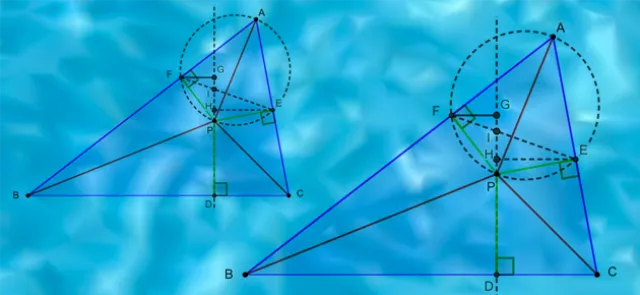
Ptolemy's little-known inequality explained | Tangente
The Greek mathematician, geographer and astronomer Claudius Ptolemy discovered a theorem about quadrilaterals inscribed in a circle in the second century CE. His result is certainly far less famous than that of his compatriot Pythagoras, but it is every bit as beautiful.

Convexity in geometry and analysis | Tangente
Convex geometry took off during the 1960s, particularly because of its applications in probability theory and optimization