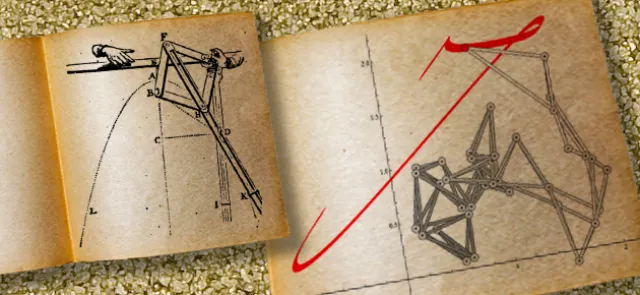
What do we call a geometric locus? Generally speaking, it is the set of all points in the plane (or in space) satisfying a given property. The perpendicular bisector of two points A and B in the plane is an elementary example, since it is the locus of points equidistant from A and B. More subtly, the ellipse is another: the set of points whose distance to two points F and F′ equals a given length a (obviously greater than the distance from F to F′). But then, one might say, every curve is a geometric locus! Not quite, actually, if we consider the modern definition of a curve as an arbitrary abstract equation… By "geometric locus", we mean that the expression must be explicit and thus lend itself to being plotted. Many approaches allow such geometric loci to be defined. Let's trace the historical evolution of this concept.
Antiquity and the ancients
-------------------------------
Euclid's work is not concerned with finding geometric loci. Apollonius, by contrast, solves many problems that are closely related to them. His interest in conics is well known; he studies, for instance, the points from which several normals can be drawn to an ellipse or a hyperbola, thus obtaining the evolute of these curves.
Archimedes' work contains many area computations. However, his definition of the spiral that bears his name is akin to a locus-finding problem. He considers a line D rotating at constant speed about a point O, and a point M that starts at O and moves away from it, likewise at constant speed (see box). Archimedes thus gives us one of the first geometric loci defined by a kinematic problem!
Four centuries later, Nicomedes, who lived in Alexandria, introduced the conchoid in a vain attempt to solve the problem of trisecting an angle. He considers a point O, a line D, and a length m. He then rotates a line about O and, denoting by P the point where meets D, considers the two points Q and R on lying on either side of P at a distance m from it (see box). This curve holds little interest today; it nevertheless remains the first known construction of a curve other than the line or the circle.
=