Harmonic ratios
--------------------
It was in the years of the baby-boom. The classic stumbling block of geometry in tenth grade (French seconde) was to find the locus of points M in the plane such that, for two given fixed points A and B, the ratio MA / MB is constant, equal to k. In those far-off days, sadistic examiners would ask this question in the oral exam for the first part of the baccalauréat, a sure recipe for disaster. Of course, the equation of the locus can be found analytically: MA2 = k 2MB2. For points A(, 0) and B(, 0), expanding this gives a circle centered on line (AB) at
and radius
.
Descartes would certainly have been satisfied, but not the proponents of synthetic geometry.
In that era when geometry reigned supreme, it was first shown that the angle bisectors at vertex M of triangle MAB meet the opposite side at points I and J such that IA / IB = JA / JB = k. After drawing the line through B parallel to side [AM], one need only apply Thales' theorem to triangles AIM and BII′, and to triangles AJM and BJJ′.
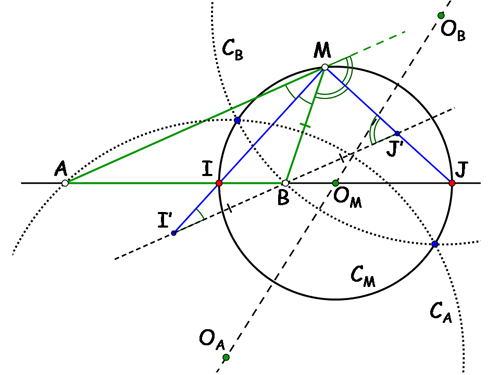
Since the angle bisectors are perpendicular, the desired locus is the circle CM with diameter [IJ]. The harmonic division [A, B, I, J] makes the pencil of lines (MA), (MI), (MB), (MJ) harmonic, but this was not taken into account in that proof.
The circle CM, the locus of point M for fixed k, is called the Apollonius circle. The circles CA and CB are constructed in the same way, using the bisectors at vertices A and B. These three circles share a common chord, and their centers lie on the Lemoine line. Many such properties reflect the geometric spirit of late 19th-century mathematicians such as Henri Brocard, Émile Lemoine, and Joseph Neuberg.
-
Terminal flux
------------------
The electric field created by an infinite straight wire with linear charge density λ is radial, by symmetry, and has magnitude
for a point located at distance r from the wire. The associated potential V is given by
{\text{V}}{(r)}=\dfrac{ \lambda}{2\pi \epsilon_0}{\text{\ln}}(r)+\text{C}
since the electric field derives from its potential. If point M moves along an equipotential, we have
.
The field line, along which the field points, is therefore orthogonal to the equipotential line.
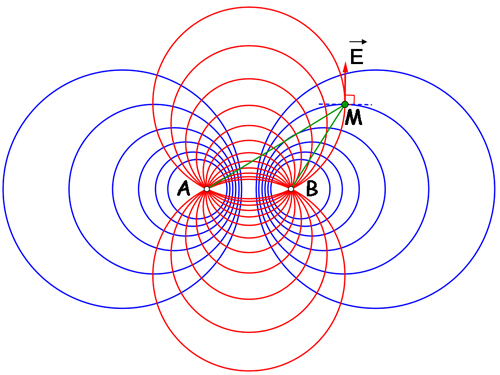
If we consider two wires perpendicular to a given plane, at A and B, with opposite linear charge densities, the potential is proportional to the quantity ln(r2 / r1 ) at a point M in the plane located at distances r2 and r1 from the wires, respectively.
The equipotentials are therefore the curves such that r2 / r1 is constant. This is the bipolar definition of the Apollonius circles, which form a pencil with the perpendicular bisector of [AB] as radical axis (blue curves). The field lines are the orthogonal trajectories (red curves) of this pencil: circles passing through A and B, with centers on the perpendicular bisector of [AB].
Together, these lines form a system of orthogonal coordinates parametrized by α and β: in a coordinate system whose x-axis is the line (AB) and whose y-axis is its perpendicular bisector,
and
where is half the distance from A to B.
For constant, we find the blue circles, with center ( cot(), 0) and radius
and for β constant, the conjugate pencil, with the y-axis as radical axis, consisting of the (red) circles with center (0, coth()) and radius
.
If the linear charge densities have the same sign, the equipotential lines are such that the product r1r2 is constant.
These are Cassini ovals, whose orthogonal curves are equilateral hyperbolas.
*
*