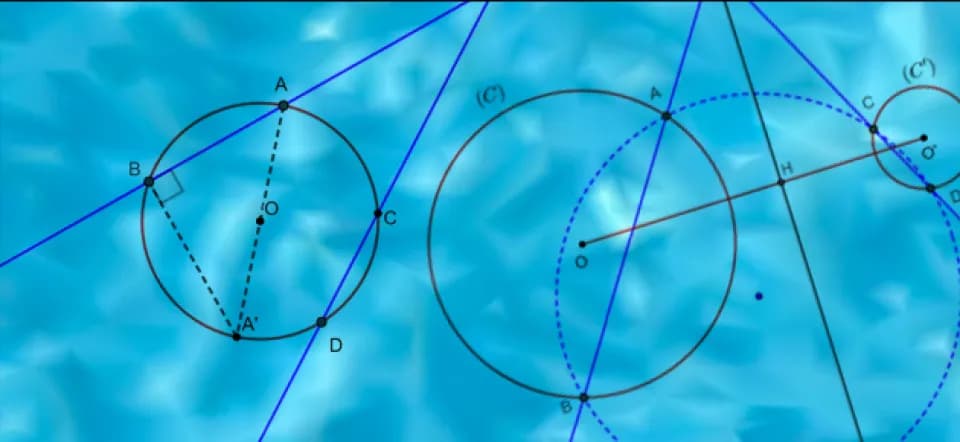
The notion has the forgotten scent of old geometry textbooks. In any case, it held pride of place in tenth-grade textbooks (French seconde) in the 1960s, where "Power of a Point with Respect to a Circle" was a chapter in its own right, complete with its applications: construction problems, conditions for points to lie on the same circle, and the search for geometric loci.
A slightly forgotten concept
------------------------
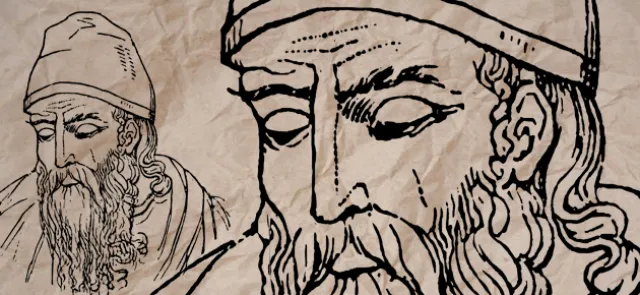
The power of a point P in the plane with respect to a conic (K) is defined as the minimum of the product of the signed lengths and , where M and N are the intersections of (K) with any line through P. The present-day definition of the power of a point with respect to a circle, regarded as a particular conic, is due to the Swiss mathematician Jakob Steiner (1796‒1863).
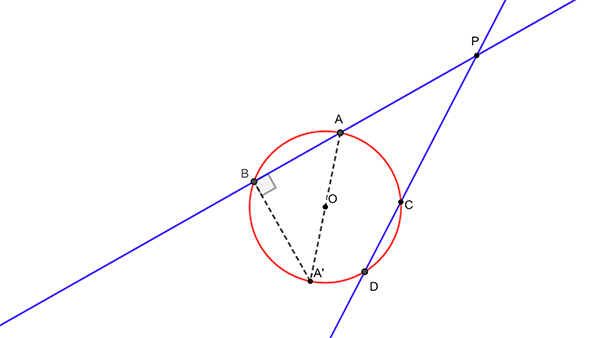
Talking about the power of a point P with respect to a circle (C) thus amounts to taking a line through P that meets (C) at A and B; the power is then exactly the product , since, in the case of a circle — a remarkable result — this product is constant whatever secant line is chosen. This is not always true for an arbitrary conic, hence the definition involving a minimum.