Direct isometries were also studied: "Direct isometries and reflections in plane geometry. Rotation about a point; point reflection. (Orthogonal) reflection across a line (axial reflection)." The composition of two such transformations was worked out in detail, leading to the group of direct isometries.
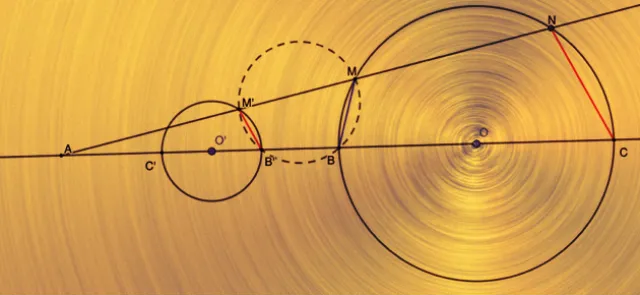
After a section on "three-dimensional geometry," homotheties and similarities were introduced. In each case, the final subsection dealt with the associated group structure: the group of homotheties and translations, and the group of direct similarities of the plane. Similarities were also expressed in terms of the complex plane. Affine transformations were not overlooked either: their definition and the image of a line were covered.
Geometry (final year of high school). Georges Cagnac and Lucien Thiberge,
Masson et compagnie, 1963.